The famous supergiant on Orion’s shoulder has rapidly dimmed, stoking excitement that a supernova may be in the offing.
Artist’s impression of the tortured, bubbling photosphere of a dying Betelgeuse. [ESO/L. Calçada]
Do you hear that ticking? Doesn’t it sound like a stellar timer is counting down to the inevitable demise of a massive star? While the excitement may be the amplified construct of social media predictions of the death of Betelgeuse, our stellar neighbor reallyis close to going supernova.
“Close”, however, is relative. It could be as “human close” as blowing up any minute now… to “galactic close” as blowing up in a hundred thousand years, maybe more.
So, what’s all the fuss about? In a nutshell, the brightest star in the famous constellation of Orion is bright no more. In the past few weeks, Betelgeuse has dimmed noticeably, stoking predictions that it could be about to spectacularly erupt at any time, becoming as bright as a full Moon and casting its own shadows at night.
While this may sound ominous, a Betelgeuse supernova poses no threat to life on Earth. It’s located a safe 600 light-years away, so if it did explode, we’d be treated to a historic cosmic firework display and not doomsday. Any energetic particles spewing from the explosion may reach the solar system in 100,000 years, but would have a minimal impact; the heliosphere (our Sun’s extended magnetic “bubble” that encompasses all the planets) would be more than powerful enough to deflect the tenuous gases.
The constellation of Orion, with the ruddy Betelgeuse in the upper left-hand corner on Orion’s “shoulder.” [Photo by Frank Cone from Pexels]
There has always been excitement over Betelgeuse and its explosive potential. It’s a massive star, with a mass 12-times that of our Sun, which has reached the end of its life. But with a lifespan of only eight million years or so, it may sound odd that it’s dying of old age. As a comparison, our Sun—an “average” yellow dwarf star—sounds geriatric in comparison; it’s approximately five billion years old. But the strange physics of stellar evolution dictates that the more massive the star, the shorter its lifespan. Betelgeuse is on borrowed time, whereas our Sun is only middle-aged. In other words, Betelgeuse has lived fast and it will dieyoung.
As a star that’s about to die, Betelgeuse is experiencing the final throes of violent processes that signify the conclusion of stellar evolution—a phase that sees a massive star puff up into a red supergiant. In the case of Betelgeuse, while it is 12-times more massive than our Sun, it has expanded into a grotesque, bubbling mess of superheated plasma, puffed up to nearly 1,000-times wider than our Sun. If Betelgeuse were transplanted into the middle of our solar system, it would swallow all the planets out to Saturn. Yes, even Jupiter would be ingested.
A precision observation of Betelgeuse’s asymmetric photosphere, highlighting bright spots and a non-spherical shape, as captured by the Atacama Large Millimeter/submillimeter Array (ALMA).
After guzzling all of its hydrogen fuel long ago, it’s now fusing heavier elements inside its tortured interior to the point where iron is being created. For any massive star, the fusion of iron is the death knell; energy is being absorbed, and soon, its immense gravity will cause the whole mess to collapse, generating an almighty shockwave that will, ultimately, rip Betelgeuse apart as a supernova.
As reported by astronomers before Christmas, the observed dimming could be interpreted as a precursor to the anticipated supernova, and for good reason. But Betelgeuse is known to regularly vary in brightness, so astronomers suspect that, while this is an unprecedented dimming event, the famous star will soon return to its “regular” brightness once more, reclaiming its rank as ninth brightest star in the sky.
In short, don’t place any serious money on Betelgeuse exploding soon. While there is a tiny chance that it might have already exploded, the light from the supernova currently galloping across the 600 light-year interstellar divide between us and Betelgeuse, it’s way more likely that it’s just Betelgeuse being Betelgeuse and keeping variable star astronomers on their toes.
That’s not to say the dimming event isn’t exciting, on the contrary. Seeing a prominent star in the night sky fade with your own eyes is something to behold, so when you get clear skies, look for Orion and ponder The Hunter’s missing shoulder.
Old stellar flashers will be caught in the act in the not-so-distant future, whether they like it or not.
[Smithsonian]
While we have a pretty good idea about how stars like our Sun work, observing all the details that unfold over millions to billions of years of stellar evolution can be difficult, especially if the phenomena occur over short timescales. Take, for example, a particularly explosive and relatively short-lived period our Sun is expected to experience in roughly five billion years.
This event is predicted to happen after our nearest star has burned up all of its hydrogen fuel and starts to burn helium. This is the beginning of the end; the Sun will swell into a vast red giant, ejecting its upper layers of plasma into space via violent solar winds, brightening 1,000 times than it is today. Needless to say, this will be a terribly dramatic time for our solar system (and a definitive apocalypse for anything that remains of our planet’s biosphere), but it will be on the verge of something even more dramatic: a helium flash.
As the solar core starts using helium as fuel, the fusion process will generate carbon and as this begins, a powerful eruption of energy will detonate, as detailed by a UC Santa Barbara statement:
A star like the sun is powered by fusing hydrogen into helium at temperatures around 15 million K. Helium, however, requires a much higher temperature than hydrogen, around 100 million K, to begin fusing into carbon, so it simply accumulates in the core while a shell of hydrogen continues to burn around it. All the while, the star expands to a size comparable to the Earth’s orbit. Eventually, the star’s core reaches the perfect conditions, triggering a violent ignition of the helium: the helium core flash. The core undergoes several flashes over the next 2 million years, and then settles into a more static state where it proceeds to burn all of the helium in the core to carbon and oxygen over the course of around 100 million years.
While the helium flashes of old Sun-like stars have been predicted for 50 years, we have yet to actually observe any kicking off in our galaxy, which isn’t so surprising considering it’s only comparatively recently that we’ve developed the techniques that are capable of precisely measuring the brightness fluctuations of distant stars. This might be about to change, according to a new study published in Nature Astronomy Letters.
“The availability of very sensitive measurements from space has made it possible to observe subtle oscillations in the brightness of a very large number of stars,” said coauthor Jørgen Christensen-Dalsgaard, of the UC Santa Barbara’s Kavli Institute for Theoretical Physics (KITP).
Christensen-Dalsgaard is referring to the growing number of space-based observatories, primed to survey the sky for transiting exoplanets—such as Kepler, CoRoT and TESS—that have extremely sensitive photonics that can detect the slightest changes in stellar brightness. And by virtue of these missions’ wide field of view, taking in the light from many stars at once, the helium flashes and resulting brightness oscillations across the stars’ surfaces could be detected in the near future.
It’s thought that the flash itself should last for no more than two million years, which may sound like a long time to we puny humans, but over cosmic timescales, that’s literally a flash—we need some serious luck to detect them. But with more observatories, longer observation periods, and wider fields of view, luck may be just around the corner.
The gas cyanogen has been detected in 2I/Borisov’s coma—a historic detection of a gas commonly found in regular comets.
Artist’s impression of a cometary nucleus. [ESA]
It’s official, the solar system is playing host to its second confirmed interstellar visitor only two years after the strangely-shaped `Oumuamua was spotted receding into interstellar expanse. While `Oumuamua was historic in that it was the first confirmed interstellar comet to be discovered, according to a new study (which has yet to be peer reviewed), this newest interstellar vagabond is potentially more significant:
“For the first time we are able to accurately measure what an interstellar visitor is made of, and compare it with our own solar system,” said Alan Fitzsimmons of the Astrophysics Research Center, Queen’s University Belfast, in a statement.
So, why are astronomers so excited about 2I/Borisov?
A (Cometary) Star Is Born
In late August, the comet was discovered by Gennady Borisov, an amateur astronomer in Crimea, and initially designated “C/2019 Q4” because, well, it looked like a regular comet. It was only after repeated observations by Borisov, and confirmed by other amateur and professional astronomers, that the object’s path and speed through the solar system could be realized. It turned out to be traveling fast.
Like, really, really fast.
Clocked at a breakneck pace of 93,000 miles per hour (150,000 kilometers per hour), astronomers realized that C/2019 Q4 was a special kind of comet. While it was found to possess the characteristics of a regular comet (it has a faint coma and tail) there is no way that it’s gravitationally bound to our Sun. Its trajectory is hyperbolic. In other words, it didn’t originate in our solar system—it’s an alien visitor.
This simple animation depicts the comets path through our neighborhood; there’s little ambiguity in the fact that it doesn’t intend to hang around for very long:
With only a slight tug by our Sun’s gravity, the interstellar visit will careen out of the solar system in a few months. [NASA/JPL-Caltech]
Last week, these factors all culminated in the International Astronomical Union (IAU) officially classifying C/2019 Q4 as the second unambiguous interstellar comet discovery to date. It was therefore reclassified as “2I/Borisov” (1I/`Oumuamua being the first, of course). It’s thought interstellar junk passes through our solar system all the time, but only two comets (to date) have been confirmed to have an interstellar origin, suggesting our observational techniques are improving.
Now, the really neat thing about 2I/Borisov is that it’s a lot more active than `Oumuamua; the latter produced very little in the way of a discernible coma or tail after its discovery. Borisov, however, is being far more generous, already allowing astronomers to grab a crude spectroscopic snapshot of the gases being vented into space.
A Mysterious Interstellar Time Capsule
After being thwarted by the glare of the Sun on Sept. 13, an international team of astronomers was able to use the William Herschel Telescope on La Palma in the Canary Islands in the morning of Sept. 20 to measure the light that was being scattered off the gases in its tenuous coma. Follow-up spectral analysis by the TRAPPIST-North telescope in Morocco was also used.
Measuring the spectrum of Borisov allows us to understand the chemical composition of the ices that are fizzing into space as they are slightly heated by our Sun’s radiation via a process known as sublimation. And this is profoundly awesome.
To capture the spectra of any comet reveals the chemicals it contained when it formed billions of years ago. In our solar system, comets are considered to be icy time capsules; they formed from the solar nebula when the Sun was a proto-star and the planets were just starting to accrete from the surrounding protoplanetary disk of ancient debris. To see the chemicals contained within the vapor of these fizzing “dirty snowballs” gives us a five-billion-year-old glimpse of what the solar nebula and its system of baby planets would have contained.
2I/Borisov as imaged by the Gemini North Telescope on Hawaii. [GEMINI OBSERVATORY/NSF/AURA/INTERNATIONAL ASTRONOMICAL UNION]
Borisov wasn’t formed in our solar nebula, however, it was formed from the nebula of a distant, unknown star of unknown age. We have little idea as to where or when it originated (though there’s little doubt that astronomers will use data from the European Gaia space telescope to try to figure out a rough estimate, as they did with `Oumuamua).
Surprisingly Familiar
While previous observations of the comet’s nucleus have revealed a reddish tinge that is similar to the long-period comets that originate from our solar system’s Oort Cloud (such as Hale-Bopp and Hyakutake), the new study has been able to identify another familiar trait: its venting gases contain cyanogen. This chemical is a simple, yet toxic molecule containing one carbon atom and a nitrogen atom (CN). Cyanogen is commonly found in regular comets born in the solar system.
The researchers were also able to make an estimate of the ratio of the dust to gas that is being blasted from the comet’s nucleus and, you guessed it, it is roughly in agreement to what you’d expect a regular comet to generate.
All of these findings point to an unexpected conclusion, as the researchers highlight in their paper: “If it were not for its interstellar nature, our current data shows that 2I/Borisov would appear as a rather unremarkable comet in terms of activity and coma composition.” In other words, if it wasn’t for its extreme speed, 2I/Borisev would look like a regular comet from our solar system.
Does this mean all comets from any star system have similar compositions? That doesn’t seem possible, considering we know other stars and their associated nebulae their comets would have formed from contain different chemicals to our own. It could just mean that Comet Borisov was ejected from a nearby star that formed in the same stellar nursery as our Sun five billion years ago and should therefore contain approximately the same chemicals. But for now, it’s too early to say.
Obviously, more work needs to be done and, fortunately, we have time. The comet will reach perihelion (point of closest approach to the Sun) in early December, and astronomers are predicting maximum nucleus activity in December and January before it starts to recede into the interstellar night.
For the festive season, our nearest star is keeping its choice of costume simple.
I’m not saying the Sun isn’t being creative, it’s just not putting too much effort into this year’s stellar fancy dress party. I mean, look at it:
The Sun right now, as seen by the Helioseismic and Magnetic Imager (HMI) instrument on NASA’s Solar Dynamics Observatory (SDO) [NASA/SDO]
That flawless orange billiard ball is the photosphere of our Sun. Have you ever seen something so smooth and beautifully unremarkable?
Well, you have now, and its blank gaze is actually the reason why it’s causing a bit of a stir. According to our ever watchful solar sentry, Tony Phillips at SpaceWeather.com, the northern summer of 2019 may go down in history as “the summer without sunspots.”
From June 21st until Sept 22nd, the sun was blank more than 89% of the time. During the entire season only 6 tiny sunspots briefly appeared, often fading so quickly that readers would complain to Spaceweather.com, “you’ve labeled a sunspot that doesn’t exist!” (No, it just disappeared.) Not a single significant solar flare was detected during this period of extreme quiet.
Sunspots are the visual cues for magnetic turmoil within our nearest star. Over cycles of approximately 11 years, the Sun’s internal magnetic field becomes stretched and twisted, driving the ebb and flow of space weather.
Starting with our solar billiard ball here, suffice to say that the solar magnetic field is pretty untwisted and, well, chilled. This is the epitome of “solar minimum” — and, as commented on by Phillips, a deep, potentially record-breaking solar minimum at that. It’s very likely that this is as minimum as solar minimum can be, so we could hazard a guess to say that things are going to start getting interesting very soon.
Differential rotation and the formation of coronal loops as demonstrated by my awesome abilities as a Microsoft Word artist [source: my PhD thesis!]
As our Sun is a massive blob of magnetized plasma, it doesn’t rotate uniformly (like the Earth does), it actually rotates a little faster at its equator than at its poles, a phenomenon known as “differential rotation.” Now, if you imagine the solar magnetic field as straight lines running from pole to pole, you can imagine that, over time, the field will start to wrap around the equator like an elastic band being stretched out of shape and wrapped around the middle. At its most extreme, so much rotational tension will be applied to the magnetic field that it becomes contorted. This contortion creates an upward pressure, forcing vast loops of magnetized plasma, known as coronal loops, to pop through the Sun’s photosphere — a.k.a. the solar “surface” — like annoyingly twisted loops of garden hosepipe (see the diagram above).
As its most extreme, in a few years time, we can expect our boring ol’ billiard ball to look something like this:
The Sun in 2014 (during the previous solar maximum), as seen by the SDO’s HMI [NASA/SDO]
About those blotches: those dark spots are sunspots and they are a direct consequence of the magnetic turmoil that rumbles inside the Sun during solar maximum. Remember those coronal loops I was talking about? Well, these huge, beautiful arcs of plasma cause the hotter outer layers of the Sun to be pushed aside, exposing the comparatively cooler (though still thousands of degrees) plasma under the surface — that’s what creates those dark blotches. And by counting sunspots, you can gauge how magnetically active the Sun is.
By viewing the Sun in different wavelengths, we can view the Sun’s atmosphere at different temperatures and, as the Sun’s atmosphere (the corona) is counter-intuitively hotter the higher above the surface you get, let’s take a look at what solar maximum looks like above these sunspots:
Yikes! The Sun’s corona in October 2014 (during the previous solar maximum), as seen by the SDO’s Atmospheric Imaging Assembly (AIA) instrument. And a damn fine effort just in time for Halloween. [NASA/SDO]
As you can see, there’s a lot of coronal loops erupting through the surface, creating huge regions of activity (called active regions, unsurprisingly). And the above observation was captured on Oct. 8, 2014, when the Sun was, apparently, in a terrifyingly festive Halloween mood! These regions can be hothouses for solar flares and coronal mass ejections; explosive phenomena that can have dramatic space weather effects on Earth.
So that was solar maximum; what does the solar corona look like now, at solar minimum?
The Sun’s corona right now, as seen by the SDO’s AIA [NASA/SDO]
Yep, as you guessed, very relaxed. In this state, we can expect very little in the way of explosive space weather events, such as flares and CMEs; there’s simply too little magnetic energy at solar minimum to create many surprises (caveat: even solar minimum can generate flares, they’re just few and far between).
While the Sun may look boring, the effects of space weather are anything but. During these times of solar minimum, the extended solar magnetic field (called the heliosphere), a magnetic bubble that reaches beyond the orbits of all the planets, contracts and weakens, allowing more cosmic rays from energetic events from the rest of the cosmos to reach Earth. Cosmic rays are ionizing particles that can boost the radiation exposure of astronauts and frequent fliers. Also, the solar wind can become a more persistent presence; streams of energized particles that are continuously streaming from the lower corona, so we still get our aurorae at high latitudes.
Recognition that the Sun is now in a deep minimum means the solar vacation is nearing an end. Astronomers have reported that of the handful of sunspots have made an appearance over the last few months with a flip in magnetic polarity, which can mean only one thing: Solar Cycle 25 is coming and the next solar maximum is only four years away.
Before zipping off to Hawaii and taking a short writing break, I was invited to appear on the SoCal Science Writing “SCIENCED” podcast with Jessie Hendricks to talk about one of our favorite habitable exoplanets, Teegarden b. So, naturally, we trashed its potential habitability with some science and humor. We also delved into some science communication, how I became a space writer, the search for extraterrestrials, and the meaning of life itself. It’s a fun discussion and Jessie is a fantastic host, check it out.
It’s both too hot and too cold, has no atmosphere, and is no place to take a vacation—but there is an upside.
Artist’s impression of LHS 3844b, which is thought to be covered in dark lava rock with no atmosphere. It’s difficult to see any upside [NASA/JPL-Caltech/R. Hurt (IPAC)]
It’s hard to say anything positive about the exoplanet LHS 3844b. It’s a wretched place; an alien world that orbits its tiny star in less than half a day. As it’s so close to its red dwarf star, it’s tidally-locked—when one side of the planet is always in baking daylight, the other side is in a perpetual frozen night. Oh, and it doesn’t even have an atmosphere.
Why the heck am I even writing about this unfortunate celestial object?
Well, it might not be our idea of an interstellar getaway, but it is remarkable for two profound reasons: It’s a rare look at the surface conditions of a rocky exoplanet orbiting a distant star, and the very fact that astronomers are confident it doesn’t have an atmosphere is a really big deal.
World of Extremes
Discovered in 2018, LHS 3844b is located nearly 49 light-years away. It has a radius 30 percent larger than Earth and orbits a cool M dwarf star. It was detected by NASA’s newest space-based exoplanet hunter, the Transiting Exoplanet Satellite Survey (TESS); every 11 hours, the world drifts in front of the star, blocking a tiny amount of light (and event known as a “transit”) that can be detected by TESS. As it orbits so close to its host star, it’s glowing bright in infrared radiation, giving the researchers of a new study published in Nature an incredible opportunity.
Using observational data from NASA’s Spitzer space telescope, which views the universe in infrared wavelengths, and as the star is comparatively cool and dim, the researchers could discern how much infrared radiation was being emitted from the exoplanet’s “day” side and calculated that it must be cooking at a temperature of 1,410 degrees Fahrenheit (770 degrees Celsius). On measuring the infrared emissions from the exoplanet’s dark side, they realized that the heat from the day side wasn’t being transported to the night side. On Earth, our atmosphere distributes thermal energy around the globe, ensuring that the night and day sides’ temperature difference isn’t so extreme. LHS 3844b, however, isn’t distributing any of its thermal energy creating a sharp drop-off in temperature between both hemispheres. In other words: no atmosphere!
“The temperature contrast on this planet is about as big as it can possibly be,” said Laura Kreidberg, a researcher at the Harvard and Smithsonian Center for Astrophysics in Cambridge, Massachusetts, and lead author of the new study. “That matches beautifully with our model of a bare rock with no atmosphere.
“We’ve got lots of theories about how planetary atmospheres fare around M dwarfs, but we haven’t been able to study them empirically. Now, with LHS 3844b, we have a terrestrial planet outside our solar system where for the first time we can determine observationally that an atmosphere is not present.”
This exoplanet has about as much atmosphere as the planet Mercury or our Moon, and it shares some other traits too. By measuring the amount of starlight the exoplanet reflects (a characteristic known as “albedo”), Kreidberg’s team also took a stab at understanding its composition.
As the world is “quite dark,” they deduced that it’s very likely that it’s covered in basalt (volcanic rock), the same stuff that we find in the crusts of the Moon and Mercury. “We know that the mare of the Moon are formed by ancient volcanism,” said Renyu Hu, an exoplanet scientist at NASA’s Jet Propulsion Laboratory in Pasadena, Calif., “and we postulate that this might be what has happened on this planet.”
An Atmospheric Problem
Red dwarfs are known to play host to entire systems of exoplanets, including many small rocky worlds of similar dimensions as Earth. Many of these worlds have been found within the much-hyped “habitable zone”, where it’s neither too hot or too cold for liquid water to persist. As we probably are all aware, liquid water is super helpful for life (on our planet, at least) to evolve. While LHS 3844b could never be considered “habitable” in any way, shape or form, the fact that it doesn’t have an atmosphere may be very revealing.
It’s simply not good enough to find a habitable zone exoplanet that orbits a red dwarf and say “there’s a good chance that aliens live there!” Even though it has the right temperature, because it’s orbiting a red dwarf and likely tidally-locked could mean these types of worlds are devoid of atmospheres, a serious wrench in the hope that all habitable zone exoplanets have the same likelihood of life. That’s not to say all red dwarf-orbiting exoplanets lack atmospheres, but now at least we are developing techniques that could, one day, help us from the atmospheric potential of more “habitable” candidates.
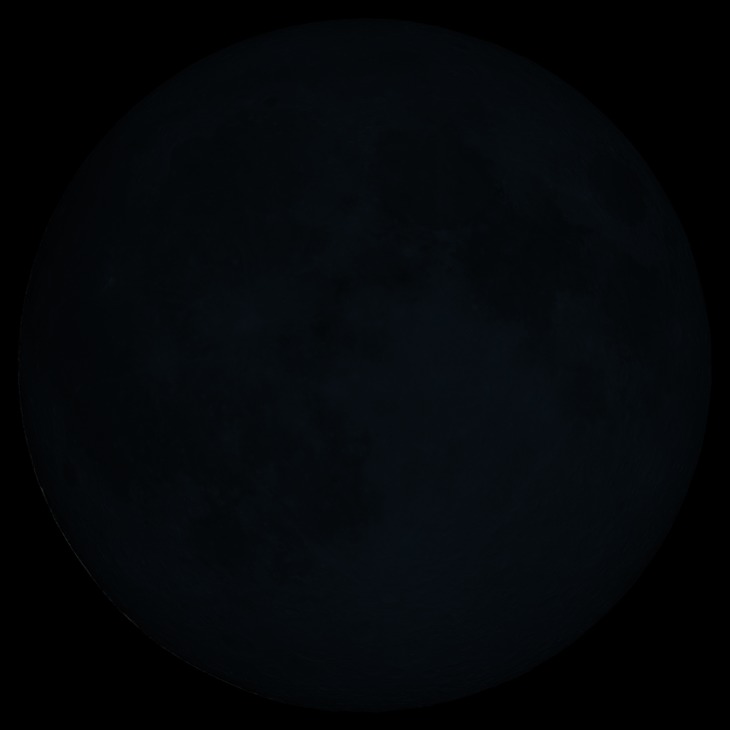
Ahhh the glorious Black Moon. Seriously, it’s there. [via NASA-SVS]
Who doesn’t love the moon? You just have to look up when the skies are clear and there it is, our lunar friend, doing its thing, changing phases, yanking at our oceans, inspiring the world to look “up.”
It’s little wonder, then, that humanity has created many different names for our planet’s tidal partner in crime. There are useful astronomical names that describe its different phases (new/full, first/third quarter, waxing/waning crescent/gibbous), but there’s also other names that have popped up throughout human history that relate to other subtleties in the lunar dance around our world. A quasi-rare second full moon of the month? Blue moon! When the full moon coincides with perigee (lunar close approach with Earth)? Supermoon! When you get a bonus lunar combo that includes a full moon, a supermoon… and the Earth is blocking the sun so we have a lunar eclipse… and it all happens to occur in January?? That’s a SUPER BLOOD WOLF MOON ECLIPSE!Because of course it is.
As you may or may not have realized, humans—particularly humans in marketing departments, the media, and astrologers with too much time on their hands—like to label things. Some of these labels can be useful, others not so much. Many are, frankly, just plain silly. Which brings me to today’s lunar branding non-event: The Black Moon. Ohh sounds… eerie.
As one who has been involved in the broadcasting field for nearly 40 years, I’d like to point out that we live in a time when the news media is seemingly obsessed with “branding.” This marketing strategy involves creating a differentiated name and image — often using a tagline — in order to establish a presence in people’s mind. In recent years in the field of astronomy, for example, we’ve seen annular eclipses — those cases when the moon is too small to completely cover the disk of the sun — become branded as “Ring of Fire” eclipses. A total eclipse of the moon — when the moon’s plunge through the Earth’s shadow causes the satellite to turn a coppery red color — is now referred to as a “Blood Moon.”
When a full moon is also passing through that part of its orbit that brings it closest to Earth — perigee — we now brand that circumstance as a supermoon. That term was actually conjured up by an astrologer back in 1979 but quite suddenly became a very popular media brand after an exceptionally close approach of a full moon to Earth in March 2011. It surprises me that even NASA now endorses the term, although it seems to me the astronomical community in general shies away from designating any perigee full moon as “super.”
Then there is Blue Moon. This moniker came about because a writer for Sky & Telescope Magazine misinterpreted an arcane definition given by a now-defunct New England Almanac for when a full moon is branded “blue,” and instead incorrectly reasoned that in a month with two full moons, the second is called a Blue Moon. That was a brand that quietly went unnoticed for some 40 years, until a syndicated radio show promoted the term in the 1980s and it then went viral. So now, even though the second full moon in a month is not the original definition for a Blue Moon, in popular culture we now automatically associate the second full moon in a calendar month with a Blue Moon.
So are you ready for yet another lunar brand? The newest one is Black Moon.
That’s a very polite way of saying, “it’s all bullshit, really.”
So, what IS a Black Moon? Well, it’s the opposite of a Blue Moon, as in it’s the second New Moon in the month of July and a New Moon is when the sun, moon and Earth are in almost exact alignment; the entire Earth-facing side of the moon is in complete shadow. The upshot is you can’t see it. It’s a naked-eye astronomical non-event.
Having said that, should the moon exactly line up with the sun, you get a solar eclipse—arguably the most mind-blowing astronomical event we can see on Earth. A plain ol’ Black Moon? Not so much.
UPDATE: As this post turned into the seed for a fun little online discussion, I added some thoughts in the following Twitter thread. Feel free to @ me:
And according to some media outlets, today's Black Moon is also a Supermoon… It's a Super Black Moon (or Black Super Moon) which makes a whole world of sense considering we can't see it. https://t.co/CvHOEd9DBc
The pair of white dwarf stars are orbiting one another every seven minutes—and future gravitational wave observatories will be able to detect them whirl.
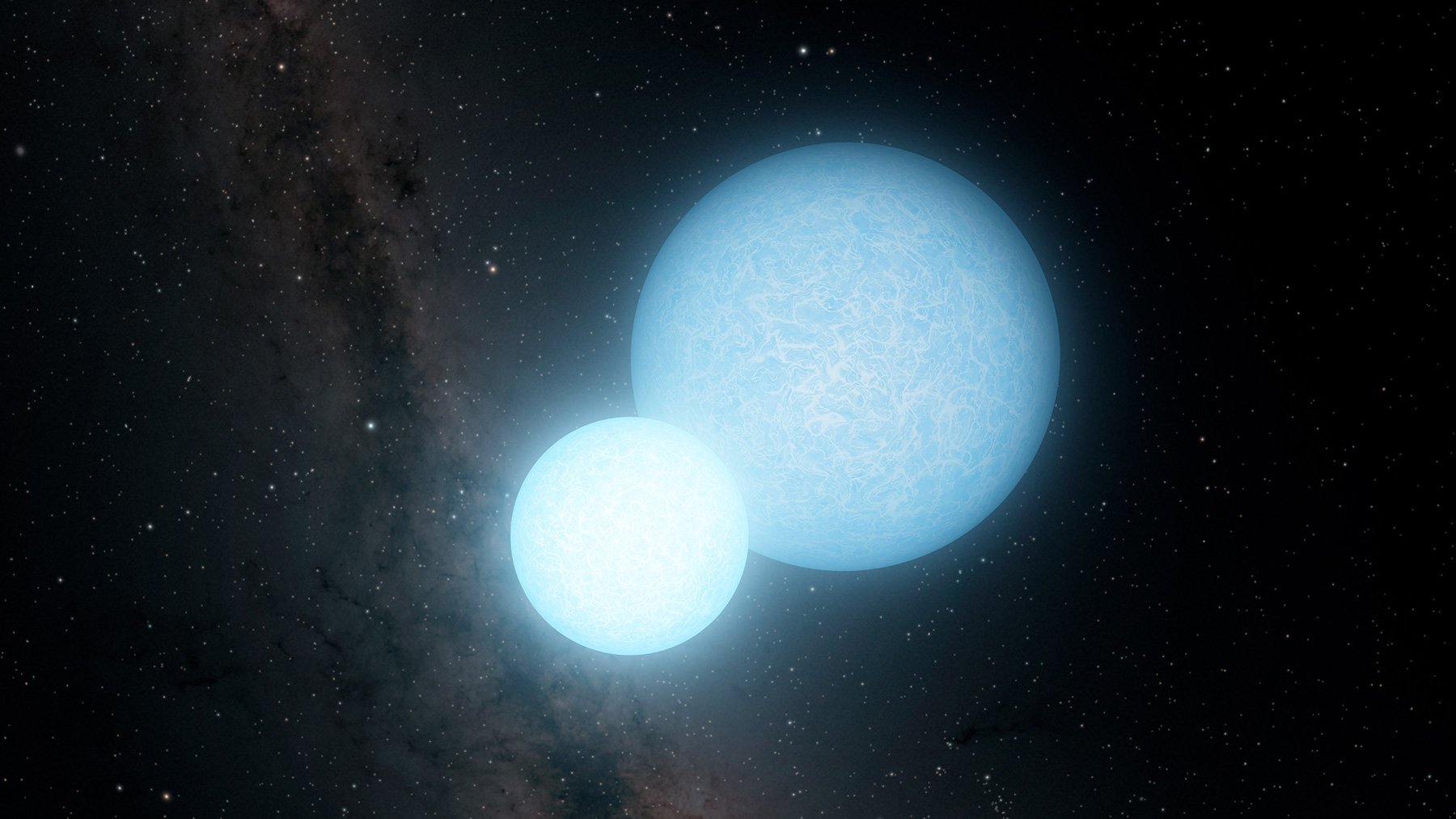
White dwarf binaries are among some of the most fascinating star systems known, and a newly discovered compact binary, located some 8,000 light-years away in the constellation Boötes, has taken the exotic nature of these systems to new spacetime-warping extremes.
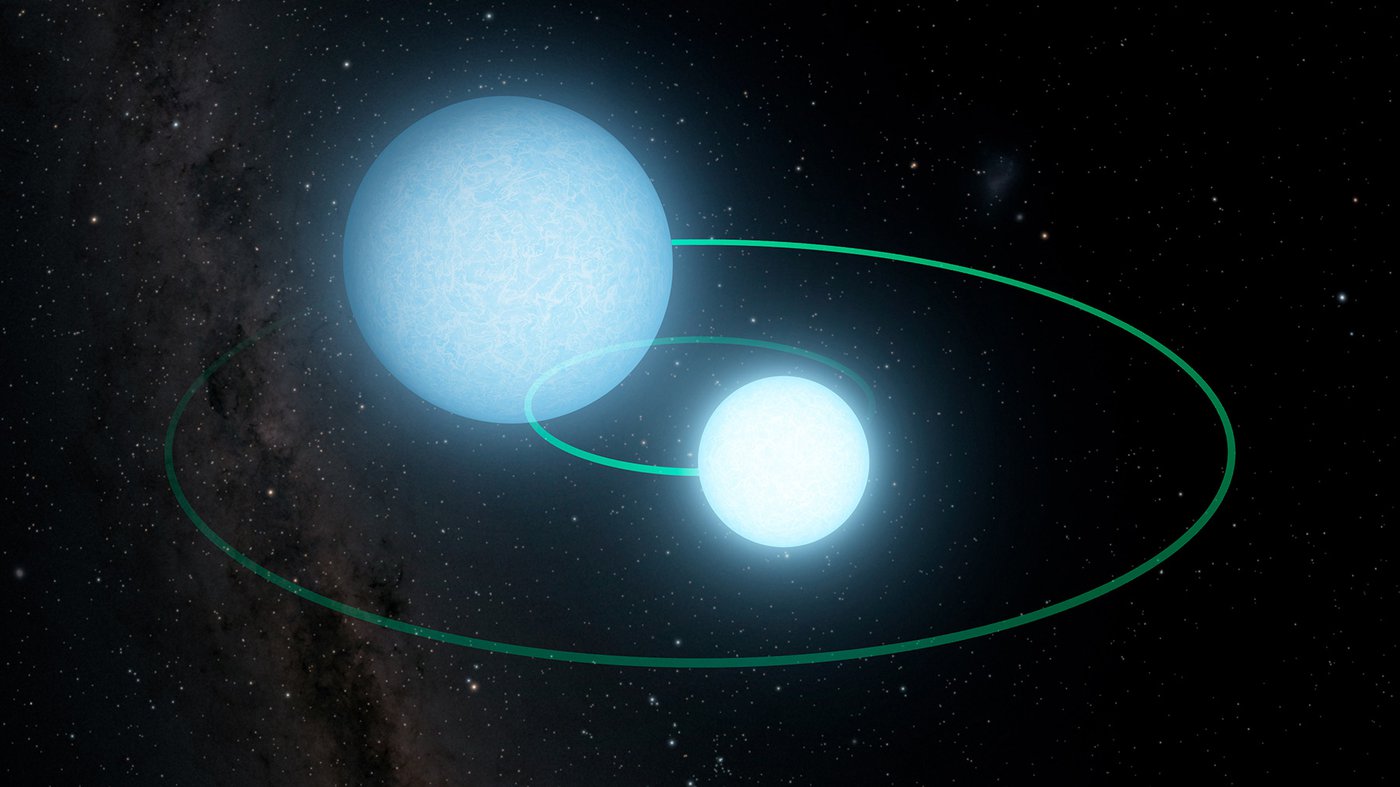
The extremely compact eclipsing binary, called ZTF J1530+5027, is one of the most extreme white dwarf systems known to exist [Caltech/IPAC]
Astronomers using Caltech’s Zwicky Transient Facility (ZTF), a precision sky survey at Palomar Observatory near San Diego in Southern California, made the discovery of ZTF J1530+5027 by detecting the dimming effect caused by one of the stars passing in front of the other. Known as an “eclipsing binary,” the cooler (and therefor dimmer) white dwarf blocks the starlight of the hotter (and brighter) star, causing the ZTF to register a periodic dimming event. This dimming occurs once every seven minutes, meaning they are zipping around each other at speeds of hundreds of miles per second! It is the second fastest white dwarf binary known and the most rapid eclipsing binary discovered in our galaxy. The fortunate alignment allows astronomers to not only precisely measure their orbital speed, they can also gauge the stars’ sizes and masses.
White dwarfs are the stellar corpses of sun-like stars that ran out of fuel long ago. Our sun will become a white dwarf in around five billion years, after it has exhausted its hydrogen fuel that maintains fusion in its core. A short period after, it will swell into a red giant (possibly expanding out as far as Earth, incinerating it) and then lose its plasma to space via powerful solar winds. All that will be left of our once glorious star will be a planetary nebula and a tiny and dense white dwarf, approximately the size of our planet, spinning in the middle. The two white dwarfs in ZTF J1530+5027 likely passed through their red giant phase at different times, but now they’re stuck, in a perpetual death spiral that spells doom for one of the objects.
To fully realize just how crazy-extreme this white dwarf binary is, they are only separated by one-fifth of the distance that the moon orbits Earth, meaning both stars would fully fit inside Saturn. They have a combined mass of our entire sun. As they orbit so snugly, it’s likely that the more massive star will start to tidally drag material from the other, cannibalizing it.
“Matter is getting ready to spill off of the bigger and lighter white dwarf onto the smaller and heavier one, which will eventually completely subsume its lighter companion,” said Kevin Burdge, Caltech graduate student and lead author of a study published in the journal Nature. “We’ve seen many examples of a type of system where one white dwarf has been mostly cannibalized by its companion, but we rarely catch these systems as they are still merging like this one.”
While impressive, the real fireworks are invisible—the stars are ripping up spacetime, generating gravitational waves that are sapping energy from the system, hastening the binary’s ultimate demise. What’s more, astronomers are anticipating that the future Laser Interferometer Space Antenna (LISA), which is scheduled for launch by the European Space Agency in 2034, will be able to detect its gravitational pulse.
“These two white dwarfs are merging because they are emitting gravitational waves,” added collaborator Tom Prince, a senior research scientist at Caltech and NASA’s Jet Propulsion Laboratory (JPL, in Pasadena, Calif. “Within a week of LISA turning on, it should pick up the gravitational waves from this system. LISA will find tens of thousands of binary systems in our galaxy like this one, but so far we only know of a few. And this binary-star system is one of the best characterized yet due to its eclipsing nature.”
This system is expected to keep blinking from our perspective for another hundred thousand years, but how will the system ultimately go kaput? Well, the researchers aren’t entirely certain. On the one hand, the more massive white dwarf may suck the other dry like a vampiric parasite, consuming all of its matter until only one, well-fed star remains. Alternatively, the act of cannibalization may cause the reverse; as mass is transferred to one star, the other may be flung outward to a wider orbit, increasing their orbital period.
“Sometimes these binary white dwarfs merge into one star, and other times the orbit widens as the lighter white dwarf is gradually shredded by the heavier one,” said co-author Jim Fuller, an assistant professor at Caltech. “We’re not sure what will happen in this case, but finding more such systems will tell us how often these stars survive their close encounters.”
One early mystery about this extreme binary is the question of X-rays, or lack thereof. The more massive star is really hot, with a temperature nine times that of the sun (50,000 Kelvin). The researchers believe that this is because it has already begun pulling material from its partner, an act that accelerates and heats the plasma that is being stolen, starting to create an accretion disk. But the accreting gas should be so hot that the system would be humming in X-rays, but it isn’t. “It’s strange that we aren’t seeing X-rays in this system. One possibility is that the accretion spots on the white dwarf—the areas the material is falling on—are bigger than what is typical, and this could result in the emission of ultraviolet light and optical light instead of X-rays,” added Burdge.
[Caltech/IPAC]
It’s exciting to think what the next generation of gravitational wave observatories (particularly LISA that will be sensitive to extremely weak spacetime ripples from systems such as these) combined with traditional (re: electromagnetic) observatories will herald for the future of astronomy. Like the emerging “multi-messenger” era for astronomy that combines observations of the electromagnetic spectrum and gravitational wave signals to confirm short gamma-ray bursts are triggered by neutron star collisions, it’s going to blow our minds when we can access more subtle gravitational wave sources such as these and directly see the gravitational energy leaking from compact binaries.
An international team of experts have teamed up to conclude that the interstellar visitor isn’t what we hoped it was.
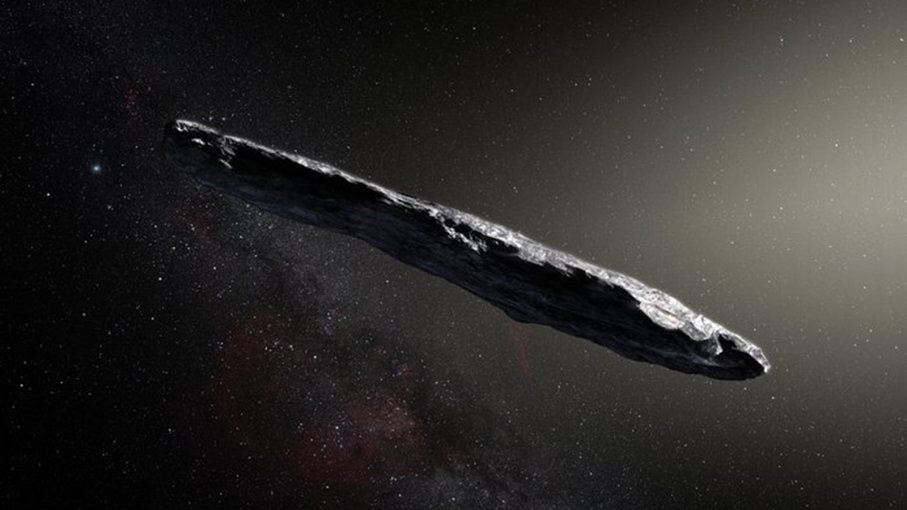
An artist’s impression of the strangely-elongated interstellar object ‘Oumuamua that zoomed through our solar system in 2017 [ESO/M. Kornmesser]
It probably comes as no surprise that the scientific consensus of ‘Oumuamua’s origins have concluded that it is a natural object, despite how funky and alien spaceship-looking the interstellar visitor at first appeared. According to a new study published today in the journal Nature Astronomy, the findings of 14 international experts have been pooled to categorically say that ‘Oumuamua isn’t an artificial object piloted by an intelligent extraterrestrial species, but instead “has a purely natural origin.”
“The alien spacecraft hypothesis is a fun idea, but our analysis suggests there is a whole host of natural phenomena that could explain it,” said the team’s leader Matthew Knight, from the University of Maryland, in a statement.
This most recent study comes hot on the heels of a fair amount of speculation that the spinning cigar-shaped object, which was detected by the Pan-STARRS1 telescope in Hawaii on Oct. 19, 2017, could be artificial. One of the more vocal advocates of this possibility, Avi Loeb of Harvard University, investigated the idea that ‘Oumuamua may be an interstellar probe that used our sun’s radiation pressure for a boost in velocity as it flew through the inner solar system. While the world’s media loved this concept (as did I), many scientists balked and emphasized the need to take the Occam’s razor approach and instead focus on natural explanations, not aliens. But, as pointed out by Loeb, while more likely explanations existed, considering the most extreme ones is still a part of the scientific process.
“This is how science works,” said Loeb in an interview for The Harvard Gazette late last year. “We make a conjecture … and if someone else advances another explanation, we will compare notes and the next time we see an object of this type we will hopefully be able to tell the difference. That’s the process by which science makes progress.”
Deep down, we all had the sense that the interstellar visitor likely wasn’t aliens (though it did spawn some wonderful debates about mind-boggling interstellar distances, the challenges of visiting other star systems, and why ET would bother popping by for a whistle-stop tour without saying “hi”), but this new study convincingly sounds the death knell for the possibility of aliens taking a joyride through our galactic neighborhood.
The new study is clear, in which the researchers write: “Here we review our knowledge and find that in all cases, the observations are consistent with a purely natural origin for ‘Oumuamua.”
So, what does the study conclude?
The object is most likely an ancient interstellar comet that randomly encountered our solar system after drifting through interstellar space for millions of years. The mechanisms by which ‘Oumuamua was ejected from its star system of birth remains up for debate, but the study’s authors point to the likelihood of a Jupiter-like world that may have gravitationally ejected the object when it strayed too close, helping it achieve escape velocity and a future lost deep in the interstellar expanse—until it encountered our solar system.
Even the behavior of the ancient comet as it traveled through the inner solar system agrees with theoretical predictions. The small boost in velocity as it made close approach to our sun was caused by ices (entombed under ‘Oumuamua’s surface) being heated and vented into space as a vapor (and not aliens hitting the gas). This behavior in comets is well-known, but the problem with ‘Oumuamua is that it exhibited few signs of being a comet—it didn’t develop a tail nor did it develop a coma, two clues of its cometary nature. But this object is different from the comets we know; it has been drifting through the galaxy for eons, perhaps it lost the majority of its ice in previous stellar encounters, or perhaps it contained little in the way of volatiles during its formation. Comets and asteroids also have a lot more in common that the textbooks may tell us, so perhaps it did vent small quantities of vapor to give it a boost, but not enough for astronomers to observe a tail and coma. In short, ‘Oumuamua shares similar traits to other objects that exist in our solar system
“While ‘Oumuamua’s interstellar origin makes it unique, many of its other properties are perfectly consistent with objects in our own solar system,” added Robert Jedicke of the University of Hawai’i’s Institute for Astronomy (IfA) and collaborator in the Nature Astronomy study.
The key thing that makes ‘Oumuamua so captivating, however, is not how it behaved when it entered the solar system and used the sun to change its course, it’s that we know it came from interstellar space, the first of its kind that we’ve ever encountered. Undoubtedly, the solar system has been visited countless times by junk that has been shed by other stars in our galaxy—there’s a lot of stars carrying around a lot of comets and asteroids, after all, they’re probably scattered around the Milky Way like baby’s toys being thrown out of strollers—but this is the first, special interstellar visitor that we’ve only just had the ability to detect.
The best news? There will be more.
Humanity is rapidly advancing through a “golden age” for astronomy and, if these interstellar vagabonds are as common as we now believe, we’re on the verge of detecting many more of them. For example, the Large Synoptic Survey Telescope (LSST), which is being constructed in Chile, is expected to become operational in 2022 and it will be so powerful that astronomers predict at least one ‘Oumuamua-like object will be spotted per year. Once we grasp how often these things turn up, perhaps we’ll be prepared enough to have a robotic spacecraft intercept one to see what these visitors from other stars really look like instead of depending on distant observations.
Of course, this whole episode could be a cautionary tale. Perhaps our advanced alien neighbors disguise their spacecraft to look like passing comets to get a closer look of primitive intelligences such as ourselves.* ‘Oumuamua being identified as an interstellar comet is exactly what they want us to believe…
*This was inspired by a tweet I read this morning, but I forgot who tweeted it and it appears I didn’t “like” it, so it’s since been lost to the twitterverse. Thank you to whomever tweeted it, it formed the seed to this blog!
While it’s an exciting discovery, the nearby star system is a very alien place with its own unique array of challenges.
The universe is stranger than we can imagine, so when a star system is discovered with some familiar traits to ours, it can be hard not to imagine extraterrestrial lifeforms and interstellar getaways. But before you dream of bathing on the exotic shores of Teegarden b, breathing in the moist and salty air, while sipping on a Teegarden Tequila Sunrise, keep in mind that the reality will likely be, well, much stranger than we can imagine.
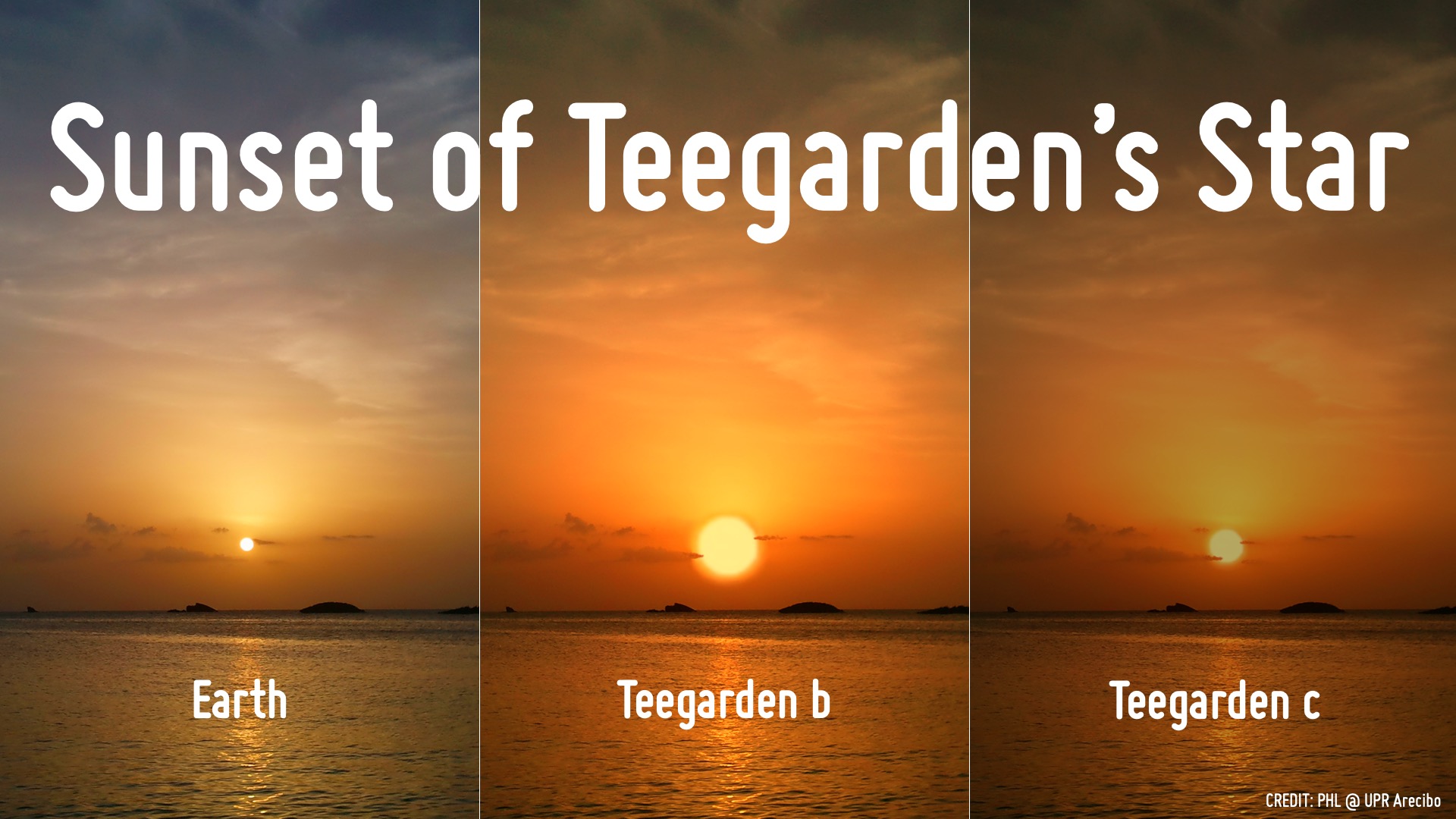
This is how the star Teegarden might look at sunset on its two “habitable” exoplanets, Teegarden b and c [PHL @ UPR Arecibo]
So, what is all the fuss about Teegarden’s Star?
This week, astronomers announced the discovery of two “habitable zone” exoplanets orbiting the tiny red dwarf star, which is located a mere interstellar stone’s throw away. While 12.5 light-years may sound like quite the trek, in galactic distances, that’s no distance at all. The two exoplanets, Teegarden b and c, are now in a very exclusive club, being the joint fourth-nearest habitable zone exoplanets to Earth (after Proxima Centauri b, Tau Ceti b and GJ 273 b). On the Earth Similarity Index (ESI), however, we have a new champion: Teegarden b—after considering its mass and derived surface temperature—this fascinating world is 95% “Earth-similar,” according to Abel Mendez’s analysis at the Planetary Habitability Laboratory (PHL). And like TRAPPIST-1, there’s some optimism that there should be more small exoplanets, some that may also be habitable, that have yet to be discovered around Teegarden.
All of these facts are cause for celebration, no? They are, but a heavy dose of reality needs to be applied when it comes to any world that has been discovered beyond our solar system.
More Exoplanets, More Possibilities
As alien planet-hunting missions continue to add more worlds to the vast menagerie of known exoplanets that exist in our galaxy, an increasing number of them are falling inside the “habitable zone” category.
Top 19 potentially habitable exoplanets, sorted by similar size and insolation to Earth [PHL @ UPR Arecibo]
The habitable zone around any star is the distance at which a rocky planet can orbit where it’s neither too hot or too cold for liquid water to exist on its surface (if it has water, that is). Liquid water is the stuff that Earth-like biology has an affinity to; without it, life on Earth wouldn’t have evolved. So, even before we have any clue about its H2O-ness, if an exoplanet is seen to have an orbit around its star that is deemed habitable, that’s +1 point for habitability.
Now, the next point can only be won if that world is also of approximate Earth-like size and/or mass. There would be little reason in getting too excited for a Jupiter-sized exoplanet sitting in the habitable zone possessing liquid water on its “surface” (because it won’t have a surface). That’s not to say there can’t be some gas giant-dwelling balloon-like alien living in there, but we’re looking for Earth-like qualities, not awesome alien qualities we read in science fiction. (I’d also argue that these kinds of exoplanets might have habitable Earth-sized moons—like Avatar‘s Pandora—but that’s for another article…)
The two key methods for exoplanet detection is the “radial velocity” method and the “transit” method. The former—which precisely measures a star’s light to detect tiny stellar wobbles as an exoplanet gravitationally “tugs” at it as it orbits—can deduce the exoplanet’s mass, thereby revealing whether or not it has an Earth-like mass (Teegarden’s two worlds were discovered using this method). The latter—which was employed by NASA’s Kepler space telescope (and now NASA’s Transiting Exoplanet Survey Explorer, among others) to look for the slight dips in brightness as an exoplanet passes in front of its star—can deduce the exoplanet’s physical size, thereby revealing whether or not it has an Earth-like size. Should a habitable zone exoplanet possess either one of these Earth-like qualities, or both (if both methods are used on a target star), that’s another +1 point for its habitability.
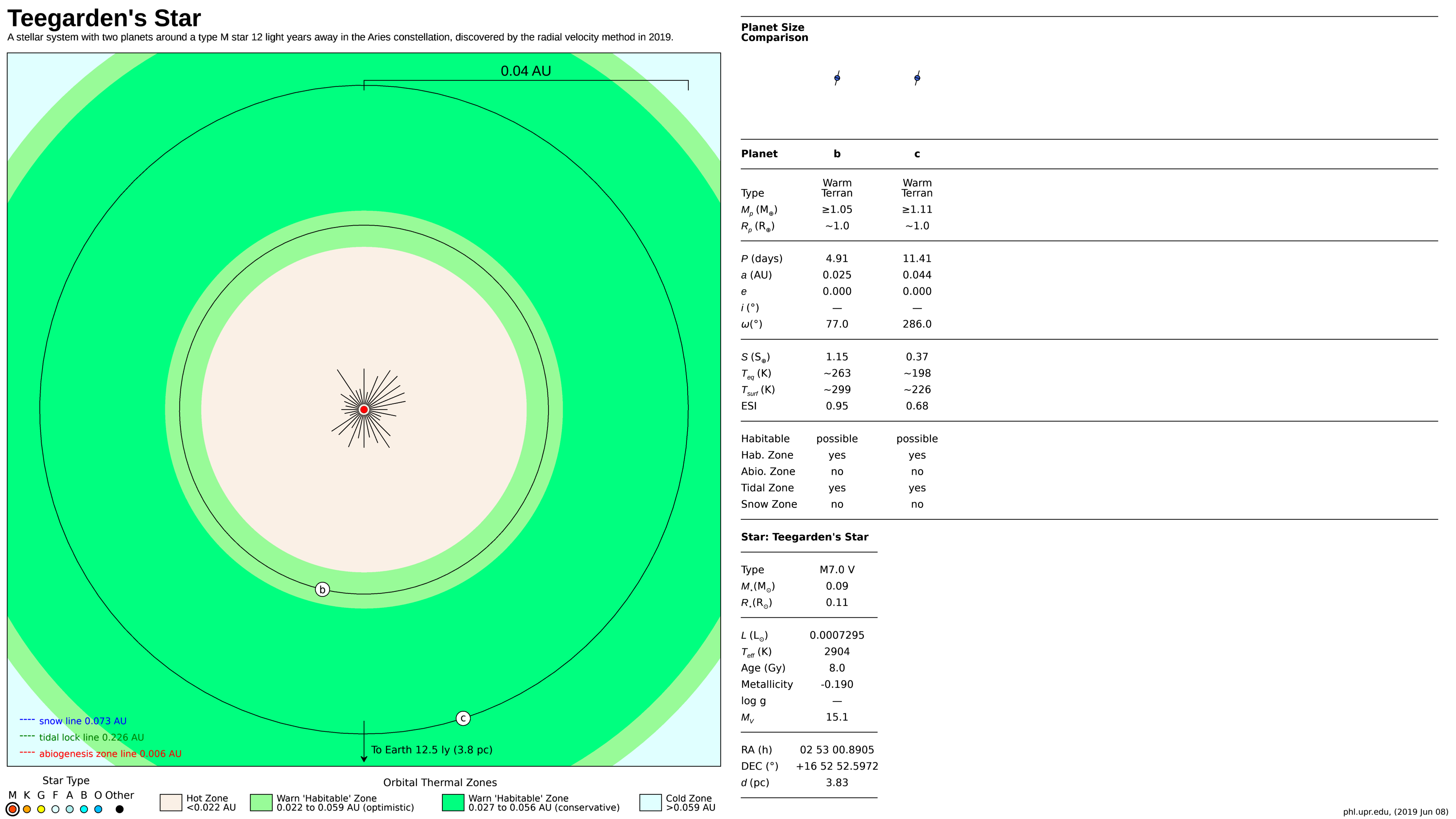
The orbital characteristics of Teegarden b and c, both falling well within the star’s habitable zone [PHL @ UPR Arecibo]
There’s a few other measurements that astronomers can make that may add to a hypothetical world’s habitability (such as observations of the host star’s flaring activity, age, or some other derived measurement), but until we develop more powerful observatories on Earth and in space, there are several factors that quickly cause our hypothetical exoplanet to diminish in habitable potential.
The Unhabitability of “Habitable” Worlds
So far in our burgeoning age of exoplanetary studies, we’ve only been able to measure (and derive) a handful of characteristics—such as mass, orbital period, physical size, density—but we have very little idea about these habitable zone exoplanets’ atmospheres. Apart from measurements of a few massive and extreme exoplanets—such as “hot-Jupiters” and exoplanets getting blow-torched by their star when they venture too close—astronomers haven’t been able to directly measure the existence of any of these “habitable” exoplanet’s hypothetical atmospheres. Do they even possess atmospheres? Or are they the opposite, with hellish Venus-like pressure-cooker atmospheres? Who knows. Even if they do have atmospheres that are more Earth-like, are the gases they contain toxic to life as we know it?
Recently, theoretical models of exoplanetary atmospheres brought carbon dioxide and carbon monoxide into the discussion. CO2 is a powerful greenhouse gas that helps maintain a balance in our atmosphere, regulating a temperate world (until industrialized humans came along, that is). But too much can be a very bad thing. For exoplanets existing on the outer edge of their habitable zone to remain habitable, they’d need massive concentrations of CO2 to remain temperate—concentrations that would render the atmosphere toxic (to complex lifeforms, at least). In the case of carbon monoxide (the terrible gas that asphyxiates anything with a cardiovascular system), as our star is so hot and bright, its ultraviolet radiation destroys large accumulations of CO in Earth’s atmosphere. But for habitable zone exoplanets that orbit cool red dwarf stars (like Teegarden), huge concentrations of CO may accumulate and snuff-out life before it has the opportunity to evolve beyond a germ. These two factors are a big negative against life as we know it, shrinking the effective habitable zone around certain stars and certain exoplanetary orbits.
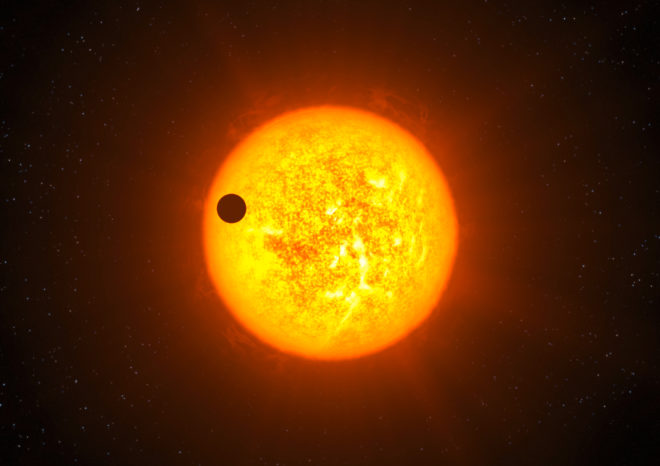
Artist impression of a transiting exoplanet [ESO]
Most habitable zone exoplanets have been found orbiting red dwarfs, primarily because our observations have been biased in favor of these little stars—they’re small and cool, meaning that any planet orbiting within their habitable zones need to get up-close and personal, so it’s an easier task to detect the periodic star wobbles or exoplanetary transits to confirm their existence.
While this may sound cute, orbiting so close to a red dwarf is a blessing (for astronomers) and a curse (for any unfortunate aliens). Many red dwarf stars generate powerful stellar flares that would regularly bombard nearby worlds with radiation that terrestrial biology would not be able to tolerate. Unless those planets have incredibly powerful global magnetic fields to, a) protect their inhabitants from being irradiated and, b) prevent the savage stellar winds from stripping away their protective atmospheres, there’s limited hope for the evolution of life.
Interestingly, however, according to the Teegarden study published in the journal Astronomy & Astrophysics, this particular red dwarf is relatively quiet on the life-killing flare front, so that’s something. Another tentative +1 for Teegarden’s actual habitability!(Pass the tequila.)
Known habitable zone exoplanets plotted against the type of star they orbit and distance from star. Note: all temperate worlds discovered so far orbit stars far cooler (and smaller) than the Sun [C. Harman]
As you can tell, there’s lots of exciting implications balanced by plenty of sobering reality checks. There is, however, one factor that is often missed from big announcements about worlds orbiting small stars that, whether they are habitable or not, is truly beyond our experience.
Eyeballing Temperate Red Dwarf Systems
Teegarden is an eight-billion-year-old star system, approximately twice the age of our solar system. If life has found a way, it will have come and gone, or be in an evolved state (though this is anyone’s guess, we have little idea about the hows and whys of the emergence of life on Earth, let alone on a different planet). But the worlds themselves, if either possess liquid water (Teegarden b, being the one that should be the most temperate of the pair, so will have the higher odds), they certainly wouldn’t look like Earth, even if they have Earth-like qualities.
Having settled billions of years ago, any orbital instabilities would have ebbed, and the planetary orbits would be clearly defined and likely in some kind of resonance with the other bodies in the star system. In addition, both Teegarden b and c will, in all likelihood, be tidally locked with their star.
To understand what this means, we need only look up. When we see our moon, we only see one hemisphere—the “near side”; the lunar “far side” is never in view. Except for the Apollo astronauts, no human has ever seen the moon’s far side with their own eyes. That’s because the moon’s rotation period (28 days) exactly matches its orbital period (28 days) around the Earth. Other examples of tidally-locked systems in the solar system are Pluto and its largest moon Charon, Mars and both its moons Phobos and Diemos, plus a whole host of moons orbiting Jupiter, Saturn, Uranus and Neptune.
The same tidal physics applies to red dwarf stars and their closely-orbiting worlds. And Teegarden b and c have very close orbits, zipping around the star once every five and eleven days, respectively, so they are very likely tidally locked, too.
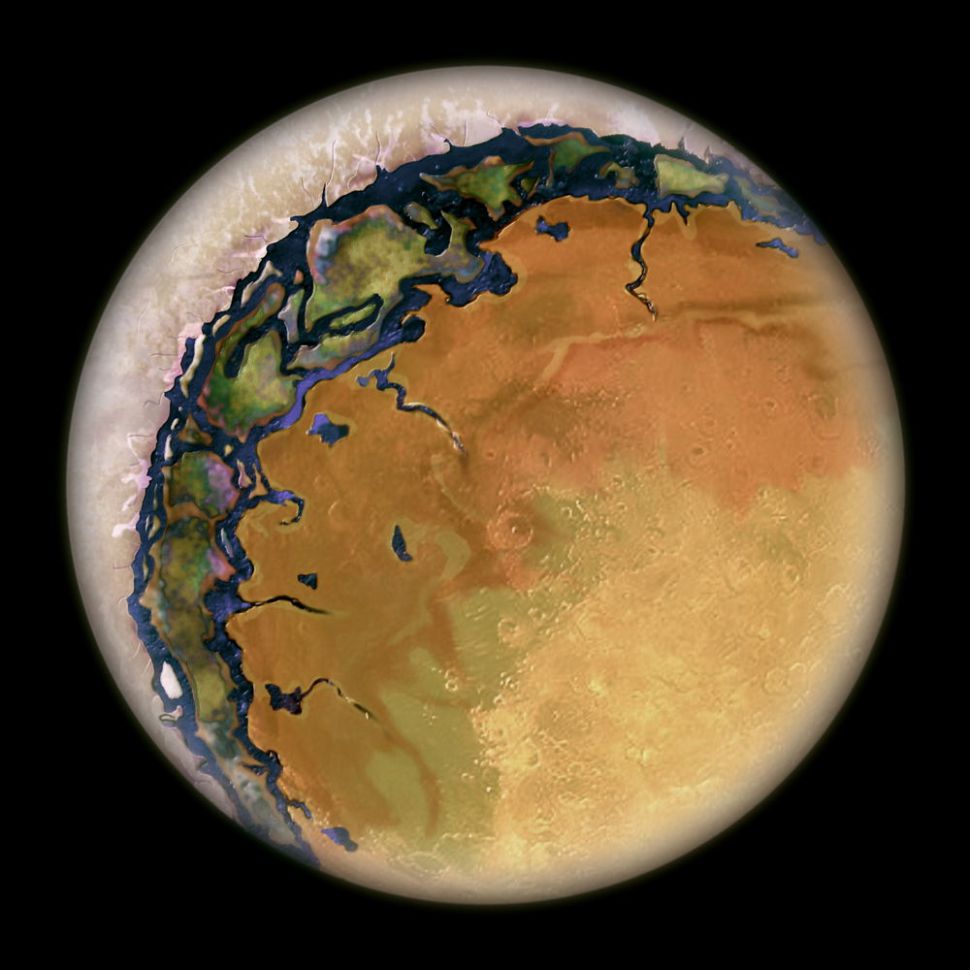
So what does a habitable zone exoplanet orbiting a red dwarf star look like? Enter the “Eyeball Earth” exoplanet:
I’ve written about this hypothetical world before and it fascinates me. As temperate exoplanets orbit red dwarfs so snugly, and if they have an atmosphere, they may too look like the above artistic rendering.
Looking like an eyeball, the star-facing hemisphere of the planet will be perpetually in daylight, whereas the opposite side will be in perpetual night. The near-side will likely be an arid desert, but the far side will be frozen. Computer simulations of the atmospheric dynamics of such a world are fascinating and well worth the read. The upshot, however, is that these worlds may have dynamic atmospheres where habitability is regulated by powerful winds that blast from the star-facing hemisphere to the night-side, transporting water vapor in a surprisingly complex manner. These worlds will never be fully-habitable, but they may host in interesting array of biological opportunities nonetheless.
For example, there may be a “ring ocean” that separates the desert from the ice, where, on one side, tributaries flow into the hot hemisphere only to be evaporated by the incessant solar heating. The vapor is then transported anti-star-ward, only to be deposited as it freezes on the night-side. One could imagine this massive buildup of ice on the planets night-side as an hemisphere-wide glacier that slowly creeps sun-ward, where it melts and pools into a temperate ring ocean where the process starts all over again.
Like Earth, the atmospheric dynamics would need to be balanced perfectly and if an alien ecosystem manages to get a foothold, perhaps such a planet-wide “water cycle” could be sustained while maintaining the life that thrives within.
“Hypothetically Habitable”
So, whenever we hear about the latest exoplanetary discovery, and take note that these strange new worlds are “Earth-like” or “habitable,” it’s worth remembering that neither may be accurate. Sure, finding an Earth-sized world in orbit around their star in the habitable zone is a great place to start, but it’s just that, a start. What about its atmosphere? Does it have the right blend of atmospheric gases? Is it toxic? Does it even have an atmosphere? Whether or not an alien world has a global magnetic field could make or break its habitable potential. Does its star have sporadic temper tantrums, dousing any local planets with a terrible radiation storm?
These challenges are no stranger to the astronomers who find these worlds and speculate on their astrobiological potential, but in the excitement that proceeds the discovery of “Earth-like” and “habitable” exoplanets, the headlines are often blind to the mechanics of what really makes a world habitable. The next step will be to directly observe the atmospheres of habitable exoplanets, a feat that may be within reach when NASA’s James Webb Space Telescope (JWST) and the ESO’s Extremely Large Telescope (ELT) go online.
The fact is, we know of only ONE habitable world, all the others are hypothetically habitable—so let’s look after this one while it can still sustain the rich and diverse ecosystem we all too often take for granted.




 astroengine.com