
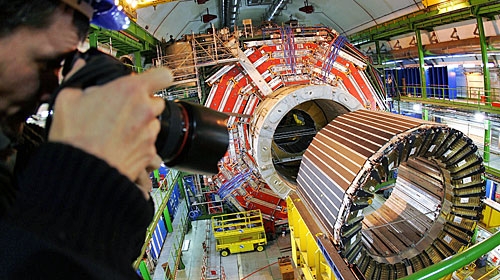
I’ve heard some crazy talk in my time, but the fear surrounding the Large Hadron Collider (LHC) at CERN has really surprised me. On writing a story last month that a guy in Hawaii (with a scant background in physics) was trying to pass a lawsuit to put a stop to the construction of the LHC, I realised the pressures physicists at the cutting edge of science are under. Physicists the world over have defended the science behind the LHC, and although some of the products from high energy particle collisions are as yet unknown, there is an infinitesimal chance that a black hole will swallow Earth… (I actually want a black hole to be created, the scientific implications will be revolutionary.)
Imagine: The year is 2010 and the LHC has carried out a variety of experiments to help prove and disprove the current state of knowledge about the Universe. All those warnings about the end of the Earth due to a black hole taking over the world and stranglets converting all matter into strange quarks are a distant memory. One experiment, though, has quite literally sent waves of excitement through the scientific world: The Hawking Radiation Experiment. Scientists have created micro black holes in the LHC, which exist for a microsecond, only to fizz out of existence. Not only that, pulses of radio waves have been detected, possibly revealing the subatomic-scale dimensions predicted by string theory…

For now, this is hopeful thinking. I hope we discover that Stephen Hawking was right after all, with experimental proof of Hawking Radiation (this would be a Nobel Prize discovery) emitting from micro-black holes. It would also be nice to be one step closer to the discovery of the Higgs Boson, but for now it is not certain that the energies produced by the LHC will be large enough. As for probing different dimensions, I am not certain this can be done, but this is what experimental physics is all about: experiment. For everyone who says “this is a huge waste of money, we have enough problems on Earth without wasting billions on crashing particles together“, you are wrong.
I don’t make any apology for having a hard-line stance for scientific development and discovery. History has taught us that scientific exploration has both harmed and benefited mankind (yes, the atomic bomb isn’t nice, but nuclear energy may well save us from our excessive consumption of energy; yes, the ICBM is now the harbinger of doom, but without that technology we wouldn’t be exploring space…), but through this development, the human race is beginning to understand the building blocks of our Universe, and the consequences of such will push us into a new era of existence. Who knows where this may lead? What’s more the LHC has been developed through peaceful applications, there is very little military application behind the science of the LHC, so the negative side of science does not apply.

So, back to the LHC. This is a very carefully thought out project. This $8 billion experiment has been constructed to probe the very small (sub-atomic particles) so we can better understand the very big (the Universe, space-time and extra-dimensions). Without this experiment, superstring theory will be no closer to being proven, Hawking Radiation will remain a theoretical curiosity and the hunt for the Higgs Boson can be abandoned. So when people with little or no understanding of the physics behind the LHC come forward claiming that they have another view that the LHC will “actually destroy the planet, and quite possibly, the entire universe“, I feel frustrated for the scientists who’s careers have been spent researching and constructing the biggest experiment we have ever conceived. They know from endless tests, theory, experiment and logic that the LHC is safe (well, to a very high degree of accuracy – after all, these are physicists), but they must defend their project and explain why the thing was built in the first place.
I can understand the fear that may be generated to non-scientists when we talk about “the highest energy collisions ever created by man“, but after careful consideration it should be realised that these collisions are happening every second in nature. Think about the supernovae, gamma ray bursts and stellar collisions occurring in nearby galaxies. To my knowledge, there’s been no space-time rip destroying life on Earth (and if we believe the reasoning behind these sensational claims that the LHC will cause disastrous perturbations in space-time, these cosmic events have far more energy and mass to cause problems than the mere spark the LHC will produce). But hold on, there are collisions of higher energies happening right here on Earth, naturally. Cosmic rays of massive energies impact our atmosphere every day, in fact, we are bathed in them! Is the world still here? I believe so.
In response to the claims that the LHC could be dangerous, CERN has a very informative website addressing these worries. Critically, just in case anyone is concerned about the creation of an Earth-eating black hole, this is pretty much impossible. Stellar black holes are gravitationally dominated singularities, their destructive power is characterised by how massive they are. The huge mass of a star 20 times the size of our Sun collapses in on itself to form a stellar black hole. The sheer mass of this black hole will pull all available local matter into its event horizon. The mass input vastly overwhelms the mass loss through Hawking evaporation – therefore the black hole will grow (if there is enough matter this stellar black hole may form an intermediate-size black hole, the link between stellar and supermassive black holes). In comparison, the possible micro-black holes created from the LHC will have a miniscule mass; they will have nearly zero gravitational effect on local matter. These micro-black holes cannot grow. In addition, should Hawking radiation be a reality, mass loss will outweigh mass input, meaning these tiny entities will evaporate exceedingly fast. A logical conclusion is therefore: micro-black holes pose no risk to the world.
Claims by the likes of Walter Wagner of Hawaii suddenly seem like a storyline from a terrible science fiction comic:
“Eventually, all of earth would fall into such growing micro-black-hole, converting earth into a medium-sized black hole, around which would continue to orbit the moon, satellites, the ISS, etc.” – Walter Wagner and Luis Sancho lawsuit, filed in U.S. District Court in Honolulu.
I must admit, I am quite impressed with his imagination – for a black hole to rampage and take over the Earth only for the satellites, ISS and the Moon to orbit around this Earth-sized black hole as if nothing had happened epitomizes the amazing science he is claiming.
Of course, these claims make for great media coverage. As the LHC switch-on date nears (summer 2008), this extra coverage is no bad thing, it simply provides particle physicists the ideal opportunity to flex their debating muscles and argue that beyond all reasonable doubt the LHC is safe and ready to begin its first science runs. We are on the cusp of a new era of physics, I’m so happy to be alive at this historic time in the advancement of human kind.
And in case you are still unconvinced, here’s an extract from the LHC safety statement at CERN:
“The total energy in each beam of protons in the LHC is equivalent to a 400 tonne train (like the French TGV) travelling at 150 km/h. However, only an infinitesimal part of this energy is released in each particle collision – roughly equivalent to the energy of a dozen flying mosquitoes. In fact, whenever you try to swat a mosquito by clapping your hands together, you create a collision energy much higher than the protons inside the LHC. The LHC’s speciality is its impressive ability to concentrate this collision energy into a minuscule area on a subatomic scale. But even this capability is just a pale shadow of what Nature achieves routinely in cosmic-ray collisions.” – CERN – Safety at the LHC.
 astroengine.com
I must admit, I am quite impressed with his imagination – for a black hole to rampage and take over the Earth only for the satellites, ISS and the Moon to orbit around this Earth-sized black hole as if nothing had happened epitomizes the stupid science he claims to have such authority over.
Er… Assuming all the mass of the Earth ends up in the black hole, and none is lost this is exactly what will happen. An orbiting body experiences the gravity of everything within its orbit as if that mass was concentrated at the centre anyway. It makes no difference whether it is spread out like the Earth as we know it or concentrated into a black hole.
At least get the basics right before you start trying to debunk the whackos.
I can see your point, and I apologise the article may not be totally clear. My argument wasn’t purely from a gravitational standpoint.
We know that vast amounts of energy is released as matter falls into the horizon of a black hole, I’m pretty sure we can expect a big explosion as the mass of the Earth is sucked into a singularity (micro-black hole as produced by the LHC). Wouldn’t this explosion of matter-energy conversion cause some local disturbances, particularly in low Earth orbit?
Also, what if the black hole forms on the surface of the Earth? I’m thinking it will drop like a stone through the planet toward the centre of mass. Depending on the speed of mass influx to the singularity, it will possibly oscillate for a while until all the matter falls in. Wouldn’t this cause further disturbances (but this time gravitational)?
Whatever the orbital characteristics of a satellite around a black hole with the same mass as the Earth, I seriously doubt the ISS, the moon and other satellites will “continue to orbit” as usual. They *might* be a little perturbed…
If you want to check out your facts I’m fairly certain you will conclude that satellites will NOT continue to orbit as usual after all the mass of the Earth is compressed into a dot (I’m thinking something fiery might happen – matter-to-energy conversion can be a messy business).
Hi Ian
Nicely put. The various physics bloggers are even more scathing of this silly law-suit and they can back up their disgust with hard numbers.
For example, a black-hole made by the LHC requires certain higher dimensional gravity theories to be true – won’t happen if they’ll wrong.
Second, the particles in the collision will almost never collide precisely enough to cancel all their relativistic motion. Virtually all will still be moving faster than Earth’s gravity can hold back – it’s because protons are composed of sub-components, which are themselves spinning at near-lightspeed.
A black hole forms when the sub-components (called partons) are concentrated in a region smaller than the Planck-scale (which is bigger due to the extra-dimensions.) That distance is about 10,000 times smaller than a proton, and the resulting black hole will be about the same size. Its gravity will be insignificant – it can only swallow other particles by coming very, very close to them. With a catchment area (called the cross-section) is ~ 1E-38 metres squared, an LHC black-hole can fall through the Earth (1E+51 proton masses) without ever running into any proton’s partons.
To get as big as a proton an LHC black hole would need to swallow 540 million tons of matter, some 3E+38 protons. If it has trouble eating just one that many will take aeons.
Ian, while I agree entirely with your sentiment “…there is an infinitesimal chance that a black hole will swallow Earth… (I actually want a black hole to be created, the scientific implications will be revolutionary.)” The (bogus) controversy over the LHC is not new. It seems that every time a new high energy experiment is proposed, or the instrument is built, a similar hysteria erupts. Perhaps a part of the problem is that those involved in the frontiers of ‘pure’ science have paid insufficient attention to mundane engineering practice like insuring that a careful risk assessment is completed AND well advertised BEFORE publicizing speculations about the experimental results. I draw your attention to a paper by Adrian Kent:
“A critical look at risk assessments for global catastrophes” (arXiv:hep-ph/0009204v6 10 Dec 2003) where he analyzes risks associated with the RHIC and ALICE collider experiments and criticizes the papers by Busza et al. (BJSW) and Dar et al. (DDH) where they argue that astrophysical data can be used to establish small bounds on the risk of a “killer strangelet” catastrophe scenario. Here he “…reappraises the DDH and BJSW risk bounds by comparing risk policy in other areas…” and finds their conclusions wanting. While some of Dr. Kent’s arguments are debatable, I do agree with him when he concludes
“In these and other areas where modeling is possible, the arguments above suggest we should encourage and pay attention to research into unlikely but not inconceivable catastrophic outcomes, and try to quantify the risk they represent…”
Perhaps we could anticipate and defuse at least some of the hysteria that seems inevitable with physics experiments before it occurs.
Q: Why all the concern now?
When funding for the LHC was approved decades ago, scientists believed that there was no reasonable danger. But then scientists discovered a few years ago that the LHC might create something called a micro black hole, and CERN then predicted that it might create micro black holes at a rate of 1 per second. And the creation of just 1 micro black hole could potentially destroy the planet in our lifetime.
Question: Do you know many cosmic rays strike a neutron star in one Earth year?
Answer: Zero, the magnetic field of a neutron star is 1,000,000,000,000 times more powerful than Earth’s!
Magnetic fields of white dwarfs are 1,000,000 times Earth’s.
Hawking Radiation is unlikely, rapid micro black hole growth is plausible, no safety arguments are verified.
LHCFacts.org
Please disregard my flawed neutron star conjecture above.
The neutron star and cosmic ray safety arguments in the 2008 LHC Safety Report were deemed “unverified” by CERN’s Scientific Policy Committee, but not for the reasons above.
Credible arguments that neutron stars do not prove safety may be found in points 5, 6 and 7 of http://www.wissensnavigator.com/documents/spiritualottoeroessler.pdf
CERN judging their own LHC is safe is like a drunk deciding he’s all right to drive… with 6,700,000,000 passengers.
Who cares about a Higgs Boson particle or some quark gluon goop except a handful of frustrated geeks who have run out of ideas and have to experiment with forces they don’t even understand. These freaking physicists waste money and energy time and time again building atom smasher after atom smasher and end up with more questions, not answers. Now they’ve built one so powerful they say themselves it will create mini black holes at the rate of one per second! Which would change your life more; knowing they found some particle or getting crushed and sucked into a black hole along with everyone and every thing you ever cared about?
That sound like a good risk vs. benefit to you?!? Just because you can’t wrap your mind around it does not mean it can’t happen.
See for yourself;
http://www.risk-evaluation-forum.org/anon1.htm
http://www.LHCDefense.org/
http://www.LHCFacts.org
http://www.SaneScience.org/
Popular Mechanics – “World’s Biggest Science Project Aims to Unlock ‘God Particle'” – http://www.popularmechanics.com/science/extreme_machines/4216588.html“
a scientific experiment — CAN and HAS gone wrong in the past — and yes, that is the UNKNOWN
that’s why most scientific experiments use GUINEA PIGS!
And the “uh, we don’t know what the outcome/or results will be – if we’ll even find the Higgs bosons at all but we ‘re sure” there will be no consequences…”
uh, Idon’t know about you but consequences and/or results is the OUTCOME of an experiment. If you don’t know in advance the OUTCOME you cannot know the consequences….duh, sorry I don’t have the IQ of Einstein but that seems very simple to me
And uh, reproducing the post nanosecond big bang state and then “controlling” what happens next seems a tad “arrogant and plain stupid” to me. The guinea pig is not a lab mouse – it’s the planet earth.
Why not do it on Mars? Oh no, we can’t…because we’re planning to terraform it.
Hi webmaster!
What I don’t understand is how everyone bemoans the scientists and makes personal comments about them (a handful of frustrated geeks who have run out of ideas).
fine if you want to have an opinion on the experiment go ahead, but don’t berate science, without which you wouldn’t be posting these comments or reading this article in this medium.
Small mindedness I think, personally if it means we get sucked into oblivion I’m all for it, we can finally get away from big brother and creationists.
Ian O’Neill wrote: “For now, this is hopeful thinking. I hope we discover that Stephen Hawking was right after all, with experimental proof of Hawking Radiation (this would be a Nobel Prize discovery) emitting from micro-black holes.”
Man, you are absolutely ilarious. No kidding. No need to worry about anything because WE HOPE the theory that would provide our safety is actually correct. And there I was, worrying about micro black holes. What a fool.
By the way, for the record I also hope Hawking’s radiation theory is correct because if we create micro black holes (as you hope elsewere in your post) but they turn out to be stable we might have a problem or two to deal with.
I should have concluded by saying, no wonder people are scared shitless by this experiment.
Why is it that people read the worst into a sentence?
What did you read? “Blah blah blah blah. Blah, blahblah blah blah blah. Blah, blah BLACK HOLE blah blah blah.”?
Hell yes, I’d love to think our feeble race has the ability to create a black hole. In theory it should be possible eventually, but the LHC probably lacks the energy to do something like this. We know by robust physics theory that a micro black hole DOES NOT have the ability to accrete matter and therefore cannot grow. We are also sure that they evaporate. If we can see Hawking radiation in action, we’ll know how they evaporate.
Don’t go jumping to conclusions and putting your faith into doomsday scenarios. As we all know, predictions of the end of the world never come true (we’re still here).
Ian, have you ever studied about clovis man and the dinos’. Good read.At least we’ve have advanced enough to choose our end.I would call it Krel syndrome.Just kidding, looking forward to know how the earth ends, wimpishly or with a bang—–big bang!
blah blah blah blah blah blah blah blah blah blah blah blah blah blah blah blah blah blah blah blah blah blah blah blah blah blah blah blah blah blah blah blah blah blah blah blah we’re all going to die.
WHO SAID BLACK HOLE?
Keep up the good work Ian
don,t forget that in 2000 when rhic began to work the same cientist that now says that the lhc is the dommsday machine, said the same thing about rich.
Wagner tried subsequently to stop full energy collision at RHIC by filing Federal lawsuits in San Francisco and New York, but without success.[32]. The New York suit was dismissed on the technicality that the San Francisco suit was the preferred forum. The San Francisco suit was dismissed, but with leave to refile if additional information was developed and presented to the court.[33]
Rich is working since 2000
i, dont understand anything about fisics but ists strange to me that the same person is tring to stop the colliders
forgive-me my whriting but i am portuguese ando y do not often wirte in english
lol, the way people seem to FANTASIZE about the end of the earth or humankind is fantastic, i honestly do not think this experiment could end the earth for the reasons so excellently given above
After they have made their first collisions, do feel free to email me if we are still here
Interesting facts.I have bookmarked this site. stephanazs
LOL
that doesn’t even make any sense!
I don’t think they’ll get all the helium out of the tunnel. It’s quite a mess. Cosmic rays – even higher energy than at the LHC … LOL … ever wondered how they measure the high energetic particles in question ? Yeah, they hold a piece of plastic towards the cosmic ray, clean the fissure with sodium hydroxide and collect the data only from that fissure. LOL !!!
Hawking radiation ? Even more LOL, can’t stop LOL !!! Exploding little black holes, decaying dark matter, H.R. – all of it – never ever observed … That really makes me LOLLLL !!!!!!!
Well, the LHC is crap and I hope it will stay that way. Otherwise we’ll make the experiment and see what happens, or as Hawking put it:
”We don’t know what we will find when we run the LHC.”
source: http://news.bbc.co.uk/today/hi/today/newsid_7605000/7605748.stm
haha! That’s what I call science. Scientists are not insolent. NO, they are NOT !!!!! LOL !!!!!!!
but what about wasting another 2 or 3 billions of Euros just to make sure we can add some more lines to our physics books and that Hawking get the noble Nobel price. No, there will be no benefits to mankind. Antimatter, black holes, strangelets etc. have no practical applications, not to mention if these things decay 🙂
We have financial experts, who were all cock sure of themselves and look at the state of the economy, now we have all of the scientists all cock sure of themselves, I wonder what mess they can make ?
I think if they have got the fundamental of the atom wrong, with Bohr and his magic mathematical orbits, if the atom is not as obvious as we think, we could be in for an interesting conclusion , so give me another plate of dark matter with a sprinkle of dark energy all mixed up with a higgs boson sauce.
From this post I know about LHC is good thing when it is properly handled otherwise it is dangerous. Thanking you for giving this message.To find your career visist staffing power.
From this post I know about LHC is good thing when it is properly handled otherwise it is dangerous. Thanking you for giving this message.To find your career visist staffing power.
Large headron collider is really an invention which we should be proud of and if it works to find the go particle then it will really be a much awaited discovery.