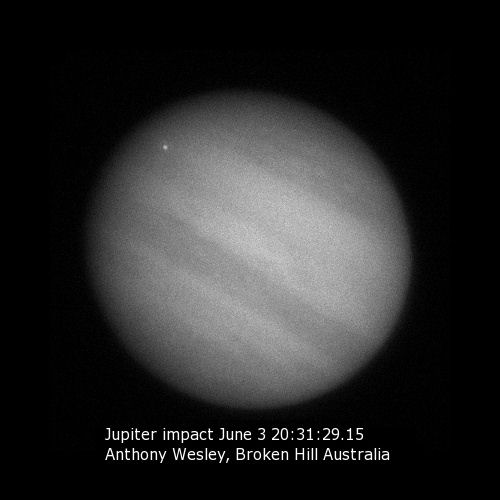
Quite frankly, I’m stunned.
An Australian amateur astronomer has just observed his second ‘once-in-a-lifetime’ event: an impact in the atmosphere of Jupiter. Phil Plait was very quick to get the news out, describing it as a “major coincidence,” and he ain’t wrong!
Anthony Wesley’s first event was the famous July 2009 observation of what was thought to have been the immediate aftermath of a comet impact in the Jovian atmosphere. His second happened on Thursday at 20:31 UTC when he was observing Jupiter when something hit the atmosphere, generating a huge fireball.
It is not known whether this event was caused by a comet or asteroid, but in a bizarre case of serendipity, earlier on Thursday Hubble released more information on his original impact event. The July 2009 “bruise” in the gas giant’s atmosphere is now thought to have been caused by an asteroid, and not a comet.
The Hubble press release included details on how researchers deduced that it was actually more likely that a 500 meter-wide asteroid hit Jupiter in 2009. One clue was that newly installed cameras on the space telescope detected little dust in the halo surrounding the impact site — a characteristic that was detected after the impact of the shards of comet Shoemaker-Levy 9 in July 1994. Also, the calculated trajectory of the 2009 event indicated the object didn’t have an orbit commonly associated with comets. If the 2009 event was an asteroid, that means Wesley saw something never seen before: the site of a recent asteroid impact on a celestial body.
And now, less than a year after being the first to see that impact aftermath, Wesley has done it again. Another amateur astronomer, Christopher Go, was quick to confirm Thursday’s fireball with a video of the 2 second flash in Jupiter’s upper atmosphere.
These impact events serve as a reminder about Jupiter’s fortuitous role in our Solar System. As the gas giant is so massive, its gravitational pull has a huge influence over the outer planets, dwarf planets, comets and asteroids. Acting like an interplanetary ‘vacuum cleaner’ Jupiter can block potentially disastrous chunks of stuff from taking a dive into the inner Solar System. It is thought that this distant planet has helped Earth become the thriving world it is today, preventing many asteroids and comets from ruining our evolution.
Thank you Jupiter!


 astroengine.com