After nine issues of editing and producing Mercury, and over two-and-a-half fantastic years of working with the wonderful staff of the ASP, I was in my element doing something I loved. This was in addition to my freelance work with HowStuffWorks, Space.com, LiveScience.com, HISTORY.com, Scientific American and others, plus the science PR gigs I picked up along the way with TRIUMF and the University of Waterloo.
After the infamous Seeker.com layoffs of 2017 that gutted our original (and, frankly, awesome) Discovery News team, choosing to be a freelance science communicator was one heck of a reality check after nearly nine years of relative job security at Discovery. That said, the past three years have also been immensely rewarding, exposing me to a brilliant community of science writers from a myriad of fields, from high-energy physics to astrobiology to Earth sciences.
But when a job opportunity emerged at one of my favorite institutions last year, I couldn’t help but pay attention and apply. After convincing myself there was “no chance” that I’d land it… land it I did.
So I’ve now traded in my freelancing for a scicomm career at…
[NASA/JPL-Caltech]
Having worked as a journalist and blogger, reporting on the incredible space robot adventures managed by the Jet Propulsion Laboratory for the past 15 years, I’ve always pondered whether my career would wind up in an institution like NASA. And I’m overjoyed that it has.
It will be a new challenge working as a media relations specialist and writer at JPL’s communications team, but I think the time had come to evolve my career to a new level while still doing the thing I love at an institution I hold in high regard. Intimately knowing the pressures, challenges, and shortfalls facing writers in science media, I hope to use everything I’ve learned over the past 15 years to effectively communicate JPL’s work to the world.
A huge thank you to everyone who has supported me over the years; I am truly grateful and I hope to make you proud as I embark on this new journey.
Earth likely passed through “a fold in the heliospheric current sheet,” which induced a powerful electrical surge down here on the ground.
While science news is filled with rumbling earthquakes and rippling gravitational waves, a different kind of perturbation was felt in Norway yesterday (Jan. 6)—but its cause is a little mysterious.
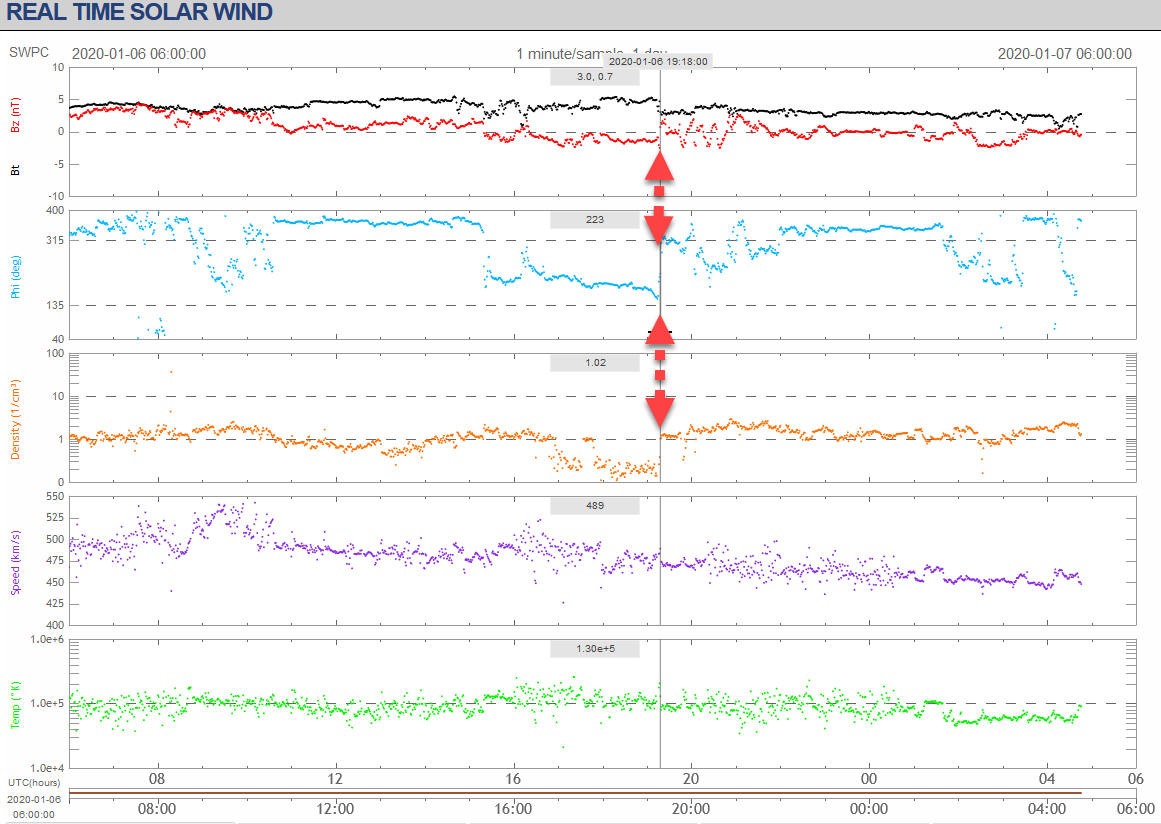
A shockwave in magnetometer data and a surge in ground currents indicated that the magnetosphere had interacted with the interplanetary magnetic field (IMF) [Rob Stammes/Polarlightcenter/Spaceweather.com]
Stammes monitors the flow of electricity through the ground and compares it with the wiggles of the Earth’s magnetic field (as plotted above). These two key measurements allow space weather scientists to better understand how our planet’s magnetosphere is being affected by the magnetic field of our Sun and how it may impact our everyday lives.
While the Sun-Earth relationship is well studied, usually magnetospheric jiggles are associated with obvious (and often explosive) solar phenomena, such as coronal mass ejections (CMEs) and powerful solar wind flows. Yesterday, however, at around 1930 UT, our magnetosphere was jolted by a phantom event.
It was as if Earth orbited through an invisible magnetic speed bump.
Before we can understand what this means (and, indeed, why it’s important), let’s take a quick trip to the biggest magnetic dynamo in the Solar System.
As you can see, the Sun isn’t currently all that active [NASA/SDO]
You know it as the giant orb of superheated plasma that gives life to Earth and dazzles you during your commute home from work, but the Sun also has an invisible magnetic dominance over all the planets. Extending from the solar interior to well beyond the orbit of Pluto, the Sun’s magnetic field creates a vast magnetic bubble called the heliosphere. Carried by the solar wind, this magnetism spirals out, through interplanetary space, interacting with any other magnetic field it may come across. In the case of our planet, our global magnetic field (the magnetosphere) is generated by the constant sloshing of molten iron in Earth’s core. Our magnetosphere reaches out into interplanetary space and, like a forcefield, it deflects the highly energetic plasma (consisting mainly of protons and some highly ionized particles) sloughing from our Sun. There’s a constant magnetic battle raging over our heads; the Sun’s magnetic field washes over our protective magnetosphere, which acts like a sea wall protecting the coastline from an unrelenting stormy ocean.
Now, if the conditions are right, the Sun’s magnetic field may breach Earth’s magnetosphere, causing the two to snap and reconnect, effectively creating a temporary magnetic marriage between the Sun and Earth. When this happens, a magnetic highway for solar particles is formed, injecting the layers of our magnetosphere with solar plasma. Ultimately, this plasma can stream along our planet’s magnetic field (or get trapped and stored), creating auroras in higher latitudes and generate electrical currents through the atmosphere and surface.
The Earth’s magnetic field warps and bends, deflecting highly energetic solar particles. But sometimes, the shield is breached, often with dramatic effect. [NASA]
Usually, space weather forecasters use a plethora of instruments to predict when this might happen. For example, they may detect a CME erupt on the corona, predict its speed, and then register a flip in the interplanetary magnetic field (IMF) by a satellite between us and the Sun (such as NASA’s Advanced Composition Explorer, or ACE, which is located at the Sun-Earth L1 point, nearly a million miles “upstream” toward the Sun). But, in the case of yesterday’s mysterious event in Norway, there was no warning for the magnetic breach in our magnetosphere. No CME, no visible increase in solar wind intensity; just a magnetic blip from ACE and a shockwave sent ripping through magnetometer stations on the ground followed by a surge in electricity through our planet’s surface.
We’d been suckerpunched by the Sun’s magnetism, but there was no obvious fist. To confirm the sudden magnetic blow (called a geomagnetic storm), magnificent auroras erupted over the poles.
So, what happened? There is a theory:
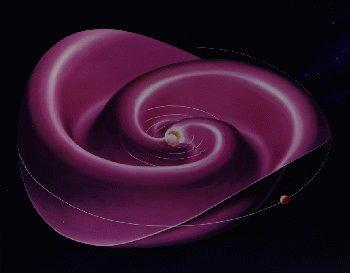
Earth may have crossed through a fold in the heliospheric current sheet—a giant, wavy membrane of electrical current rippling through the solar system. Such crossings can cause these kind of effects.
Looking like the warped disk of an old vinyl record, the heliospheric current sheet ripples throughout the solar system. As Earth rotates around the Sun, it will pass through the “surface” of this sheet, where the magnetic polarity of the IMF will rapidly change. And this is probably what happened yesterday. As the Earth orbited through a fold in the sheet, the magnetic polarity flipped 180 degrees, creating the phantom interaction with our magnetosphere. This, in turn, released solar particles that had been trapped in the layers of our magnetosphere, causing them to surge through the upper atmosphere, creating an intense—and surprise—auroral display.
Predicting when these events are going to occur is critical to space weather prediction efforts. As demonstrated by Stammes’ measurements of currents flowing through the ground, geomagnetic storms can overload national power grids, leaving entire nations (or, potentially, entire continents) in the dark.
While this Norway event didn’t cause reported damage to any infrastructure, it is a reminder that our planet’s interactions with the solar magnetic field—and subsequent impacts to our civilization—can be unpredictable and, in this case, invisible.
The famous supergiant on Orion’s shoulder has rapidly dimmed, stoking excitement that a supernova may be in the offing.
Artist’s impression of the tortured, bubbling photosphere of a dying Betelgeuse. [ESO/L. Calçada]
Do you hear that ticking? Doesn’t it sound like a stellar timer is counting down to the inevitable demise of a massive star? While the excitement may be the amplified construct of social media predictions of the death of Betelgeuse, our stellar neighbor reallyis close to going supernova.
“Close”, however, is relative. It could be as “human close” as blowing up any minute now… to “galactic close” as blowing up in a hundred thousand years, maybe more.
So, what’s all the fuss about? In a nutshell, the brightest star in the famous constellation of Orion is bright no more. In the past few weeks, Betelgeuse has dimmed noticeably, stoking predictions that it could be about to spectacularly erupt at any time, becoming as bright as a full Moon and casting its own shadows at night.
While this may sound ominous, a Betelgeuse supernova poses no threat to life on Earth. It’s located a safe 600 light-years away, so if it did explode, we’d be treated to a historic cosmic firework display and not doomsday. Any energetic particles spewing from the explosion may reach the solar system in 100,000 years, but would have a minimal impact; the heliosphere (our Sun’s extended magnetic “bubble” that encompasses all the planets) would be more than powerful enough to deflect the tenuous gases.
The constellation of Orion, with the ruddy Betelgeuse in the upper left-hand corner on Orion’s “shoulder.” [Photo by Frank Cone from Pexels]
There has always been excitement over Betelgeuse and its explosive potential. It’s a massive star, with a mass 12-times that of our Sun, which has reached the end of its life. But with a lifespan of only eight million years or so, it may sound odd that it’s dying of old age. As a comparison, our Sun—an “average” yellow dwarf star—sounds geriatric in comparison; it’s approximately five billion years old. But the strange physics of stellar evolution dictates that the more massive the star, the shorter its lifespan. Betelgeuse is on borrowed time, whereas our Sun is only middle-aged. In other words, Betelgeuse has lived fast and it will dieyoung.
As a star that’s about to die, Betelgeuse is experiencing the final throes of violent processes that signify the conclusion of stellar evolution—a phase that sees a massive star puff up into a red supergiant. In the case of Betelgeuse, while it is 12-times more massive than our Sun, it has expanded into a grotesque, bubbling mess of superheated plasma, puffed up to nearly 1,000-times wider than our Sun. If Betelgeuse were transplanted into the middle of our solar system, it would swallow all the planets out to Saturn. Yes, even Jupiter would be ingested.
A precision observation of Betelgeuse’s asymmetric photosphere, highlighting bright spots and a non-spherical shape, as captured by the Atacama Large Millimeter/submillimeter Array (ALMA).
After guzzling all of its hydrogen fuel long ago, it’s now fusing heavier elements inside its tortured interior to the point where iron is being created. For any massive star, the fusion of iron is the death knell; energy is being absorbed, and soon, its immense gravity will cause the whole mess to collapse, generating an almighty shockwave that will, ultimately, rip Betelgeuse apart as a supernova.
As reported by astronomers before Christmas, the observed dimming could be interpreted as a precursor to the anticipated supernova, and for good reason. But Betelgeuse is known to regularly vary in brightness, so astronomers suspect that, while this is an unprecedented dimming event, the famous star will soon return to its “regular” brightness once more, reclaiming its rank as ninth brightest star in the sky.
In short, don’t place any serious money on Betelgeuse exploding soon. While there is a tiny chance that it might have already exploded, the light from the supernova currently galloping across the 600 light-year interstellar divide between us and Betelgeuse, it’s way more likely that it’s just Betelgeuse being Betelgeuse and keeping variable star astronomers on their toes.
That’s not to say the dimming event isn’t exciting, on the contrary. Seeing a prominent star in the night sky fade with your own eyes is something to behold, so when you get clear skies, look for Orion and ponder The Hunter’s missing shoulder.
Old stellar flashers will be caught in the act in the not-so-distant future, whether they like it or not.
[Smithsonian]
While we have a pretty good idea about how stars like our Sun work, observing all the details that unfold over millions to billions of years of stellar evolution can be difficult, especially if the phenomena occur over short timescales. Take, for example, a particularly explosive and relatively short-lived period our Sun is expected to experience in roughly five billion years.
This event is predicted to happen after our nearest star has burned up all of its hydrogen fuel and starts to burn helium. This is the beginning of the end; the Sun will swell into a vast red giant, ejecting its upper layers of plasma into space via violent solar winds, brightening 1,000 times than it is today. Needless to say, this will be a terribly dramatic time for our solar system (and a definitive apocalypse for anything that remains of our planet’s biosphere), but it will be on the verge of something even more dramatic: a helium flash.
As the solar core starts using helium as fuel, the fusion process will generate carbon and as this begins, a powerful eruption of energy will detonate, as detailed by a UC Santa Barbara statement:
A star like the sun is powered by fusing hydrogen into helium at temperatures around 15 million K. Helium, however, requires a much higher temperature than hydrogen, around 100 million K, to begin fusing into carbon, so it simply accumulates in the core while a shell of hydrogen continues to burn around it. All the while, the star expands to a size comparable to the Earth’s orbit. Eventually, the star’s core reaches the perfect conditions, triggering a violent ignition of the helium: the helium core flash. The core undergoes several flashes over the next 2 million years, and then settles into a more static state where it proceeds to burn all of the helium in the core to carbon and oxygen over the course of around 100 million years.
While the helium flashes of old Sun-like stars have been predicted for 50 years, we have yet to actually observe any kicking off in our galaxy, which isn’t so surprising considering it’s only comparatively recently that we’ve developed the techniques that are capable of precisely measuring the brightness fluctuations of distant stars. This might be about to change, according to a new study published in Nature Astronomy Letters.
“The availability of very sensitive measurements from space has made it possible to observe subtle oscillations in the brightness of a very large number of stars,” said coauthor Jørgen Christensen-Dalsgaard, of the UC Santa Barbara’s Kavli Institute for Theoretical Physics (KITP).
Christensen-Dalsgaard is referring to the growing number of space-based observatories, primed to survey the sky for transiting exoplanets—such as Kepler, CoRoT and TESS—that have extremely sensitive photonics that can detect the slightest changes in stellar brightness. And by virtue of these missions’ wide field of view, taking in the light from many stars at once, the helium flashes and resulting brightness oscillations across the stars’ surfaces could be detected in the near future.
It’s thought that the flash itself should last for no more than two million years, which may sound like a long time to we puny humans, but over cosmic timescales, that’s literally a flash—we need some serious luck to detect them. But with more observatories, longer observation periods, and wider fields of view, luck may be just around the corner.
The gas cyanogen has been detected in 2I/Borisov’s coma—a historic detection of a gas commonly found in regular comets.
Artist’s impression of a cometary nucleus. [ESA]
It’s official, the solar system is playing host to its second confirmed interstellar visitor only two years after the strangely-shaped `Oumuamua was spotted receding into interstellar expanse. While `Oumuamua was historic in that it was the first confirmed interstellar comet to be discovered, according to a new study (which has yet to be peer reviewed), this newest interstellar vagabond is potentially more significant:
“For the first time we are able to accurately measure what an interstellar visitor is made of, and compare it with our own solar system,” said Alan Fitzsimmons of the Astrophysics Research Center, Queen’s University Belfast, in a statement.
So, why are astronomers so excited about 2I/Borisov?
A (Cometary) Star Is Born
In late August, the comet was discovered by Gennady Borisov, an amateur astronomer in Crimea, and initially designated “C/2019 Q4” because, well, it looked like a regular comet. It was only after repeated observations by Borisov, and confirmed by other amateur and professional astronomers, that the object’s path and speed through the solar system could be realized. It turned out to be traveling fast.
Like, really, really fast.
Clocked at a breakneck pace of 93,000 miles per hour (150,000 kilometers per hour), astronomers realized that C/2019 Q4 was a special kind of comet. While it was found to possess the characteristics of a regular comet (it has a faint coma and tail) there is no way that it’s gravitationally bound to our Sun. Its trajectory is hyperbolic. In other words, it didn’t originate in our solar system—it’s an alien visitor.
This simple animation depicts the comets path through our neighborhood; there’s little ambiguity in the fact that it doesn’t intend to hang around for very long:
With only a slight tug by our Sun’s gravity, the interstellar visit will careen out of the solar system in a few months. [NASA/JPL-Caltech]
Last week, these factors all culminated in the International Astronomical Union (IAU) officially classifying C/2019 Q4 as the second unambiguous interstellar comet discovery to date. It was therefore reclassified as “2I/Borisov” (1I/`Oumuamua being the first, of course). It’s thought interstellar junk passes through our solar system all the time, but only two comets (to date) have been confirmed to have an interstellar origin, suggesting our observational techniques are improving.
Now, the really neat thing about 2I/Borisov is that it’s a lot more active than `Oumuamua; the latter produced very little in the way of a discernible coma or tail after its discovery. Borisov, however, is being far more generous, already allowing astronomers to grab a crude spectroscopic snapshot of the gases being vented into space.
A Mysterious Interstellar Time Capsule
After being thwarted by the glare of the Sun on Sept. 13, an international team of astronomers was able to use the William Herschel Telescope on La Palma in the Canary Islands in the morning of Sept. 20 to measure the light that was being scattered off the gases in its tenuous coma. Follow-up spectral analysis by the TRAPPIST-North telescope in Morocco was also used.
Measuring the spectrum of Borisov allows us to understand the chemical composition of the ices that are fizzing into space as they are slightly heated by our Sun’s radiation via a process known as sublimation. And this is profoundly awesome.
To capture the spectra of any comet reveals the chemicals it contained when it formed billions of years ago. In our solar system, comets are considered to be icy time capsules; they formed from the solar nebula when the Sun was a proto-star and the planets were just starting to accrete from the surrounding protoplanetary disk of ancient debris. To see the chemicals contained within the vapor of these fizzing “dirty snowballs” gives us a five-billion-year-old glimpse of what the solar nebula and its system of baby planets would have contained.
2I/Borisov as imaged by the Gemini North Telescope on Hawaii. [GEMINI OBSERVATORY/NSF/AURA/INTERNATIONAL ASTRONOMICAL UNION]
Borisov wasn’t formed in our solar nebula, however, it was formed from the nebula of a distant, unknown star of unknown age. We have little idea as to where or when it originated (though there’s little doubt that astronomers will use data from the European Gaia space telescope to try to figure out a rough estimate, as they did with `Oumuamua).
Surprisingly Familiar
While previous observations of the comet’s nucleus have revealed a reddish tinge that is similar to the long-period comets that originate from our solar system’s Oort Cloud (such as Hale-Bopp and Hyakutake), the new study has been able to identify another familiar trait: its venting gases contain cyanogen. This chemical is a simple, yet toxic molecule containing one carbon atom and a nitrogen atom (CN). Cyanogen is commonly found in regular comets born in the solar system.
The researchers were also able to make an estimate of the ratio of the dust to gas that is being blasted from the comet’s nucleus and, you guessed it, it is roughly in agreement to what you’d expect a regular comet to generate.
All of these findings point to an unexpected conclusion, as the researchers highlight in their paper: “If it were not for its interstellar nature, our current data shows that 2I/Borisov would appear as a rather unremarkable comet in terms of activity and coma composition.” In other words, if it wasn’t for its extreme speed, 2I/Borisev would look like a regular comet from our solar system.
Does this mean all comets from any star system have similar compositions? That doesn’t seem possible, considering we know other stars and their associated nebulae their comets would have formed from contain different chemicals to our own. It could just mean that Comet Borisov was ejected from a nearby star that formed in the same stellar nursery as our Sun five billion years ago and should therefore contain approximately the same chemicals. But for now, it’s too early to say.
Obviously, more work needs to be done and, fortunately, we have time. The comet will reach perihelion (point of closest approach to the Sun) in early December, and astronomers are predicting maximum nucleus activity in December and January before it starts to recede into the interstellar night.
For the festive season, our nearest star is keeping its choice of costume simple.
I’m not saying the Sun isn’t being creative, it’s just not putting too much effort into this year’s stellar fancy dress party. I mean, look at it:
The Sun right now, as seen by the Helioseismic and Magnetic Imager (HMI) instrument on NASA’s Solar Dynamics Observatory (SDO) [NASA/SDO]
That flawless orange billiard ball is the photosphere of our Sun. Have you ever seen something so smooth and beautifully unremarkable?
Well, you have now, and its blank gaze is actually the reason why it’s causing a bit of a stir. According to our ever watchful solar sentry, Tony Phillips at SpaceWeather.com, the northern summer of 2019 may go down in history as “the summer without sunspots.”
From June 21st until Sept 22nd, the sun was blank more than 89% of the time. During the entire season only 6 tiny sunspots briefly appeared, often fading so quickly that readers would complain to Spaceweather.com, “you’ve labeled a sunspot that doesn’t exist!” (No, it just disappeared.) Not a single significant solar flare was detected during this period of extreme quiet.
Sunspots are the visual cues for magnetic turmoil within our nearest star. Over cycles of approximately 11 years, the Sun’s internal magnetic field becomes stretched and twisted, driving the ebb and flow of space weather.
Starting with our solar billiard ball here, suffice to say that the solar magnetic field is pretty untwisted and, well, chilled. This is the epitome of “solar minimum” — and, as commented on by Phillips, a deep, potentially record-breaking solar minimum at that. It’s very likely that this is as minimum as solar minimum can be, so we could hazard a guess to say that things are going to start getting interesting very soon.
Differential rotation and the formation of coronal loops as demonstrated by my awesome abilities as a Microsoft Word artist [source: my PhD thesis!]
As our Sun is a massive blob of magnetized plasma, it doesn’t rotate uniformly (like the Earth does), it actually rotates a little faster at its equator than at its poles, a phenomenon known as “differential rotation.” Now, if you imagine the solar magnetic field as straight lines running from pole to pole, you can imagine that, over time, the field will start to wrap around the equator like an elastic band being stretched out of shape and wrapped around the middle. At its most extreme, so much rotational tension will be applied to the magnetic field that it becomes contorted. This contortion creates an upward pressure, forcing vast loops of magnetized plasma, known as coronal loops, to pop through the Sun’s photosphere — a.k.a. the solar “surface” — like annoyingly twisted loops of garden hosepipe (see the diagram above).
As its most extreme, in a few years time, we can expect our boring ol’ billiard ball to look something like this:
The Sun in 2014 (during the previous solar maximum), as seen by the SDO’s HMI [NASA/SDO]
About those blotches: those dark spots are sunspots and they are a direct consequence of the magnetic turmoil that rumbles inside the Sun during solar maximum. Remember those coronal loops I was talking about? Well, these huge, beautiful arcs of plasma cause the hotter outer layers of the Sun to be pushed aside, exposing the comparatively cooler (though still thousands of degrees) plasma under the surface — that’s what creates those dark blotches. And by counting sunspots, you can gauge how magnetically active the Sun is.
By viewing the Sun in different wavelengths, we can view the Sun’s atmosphere at different temperatures and, as the Sun’s atmosphere (the corona) is counter-intuitively hotter the higher above the surface you get, let’s take a look at what solar maximum looks like above these sunspots:
Yikes! The Sun’s corona in October 2014 (during the previous solar maximum), as seen by the SDO’s Atmospheric Imaging Assembly (AIA) instrument. And a damn fine effort just in time for Halloween. [NASA/SDO]
As you can see, there’s a lot of coronal loops erupting through the surface, creating huge regions of activity (called active regions, unsurprisingly). And the above observation was captured on Oct. 8, 2014, when the Sun was, apparently, in a terrifyingly festive Halloween mood! These regions can be hothouses for solar flares and coronal mass ejections; explosive phenomena that can have dramatic space weather effects on Earth.
So that was solar maximum; what does the solar corona look like now, at solar minimum?
The Sun’s corona right now, as seen by the SDO’s AIA [NASA/SDO]
Yep, as you guessed, very relaxed. In this state, we can expect very little in the way of explosive space weather events, such as flares and CMEs; there’s simply too little magnetic energy at solar minimum to create many surprises (caveat: even solar minimum can generate flares, they’re just few and far between).
While the Sun may look boring, the effects of space weather are anything but. During these times of solar minimum, the extended solar magnetic field (called the heliosphere), a magnetic bubble that reaches beyond the orbits of all the planets, contracts and weakens, allowing more cosmic rays from energetic events from the rest of the cosmos to reach Earth. Cosmic rays are ionizing particles that can boost the radiation exposure of astronauts and frequent fliers. Also, the solar wind can become a more persistent presence; streams of energized particles that are continuously streaming from the lower corona, so we still get our aurorae at high latitudes.
Recognition that the Sun is now in a deep minimum means the solar vacation is nearing an end. Astronomers have reported that of the handful of sunspots have made an appearance over the last few months with a flip in magnetic polarity, which can mean only one thing: Solar Cycle 25 is coming and the next solar maximum is only four years away.
Before zipping off to Hawaii and taking a short writing break, I was invited to appear on the SoCal Science Writing “SCIENCED” podcast with Jessie Hendricks to talk about one of our favorite habitable exoplanets, Teegarden b. So, naturally, we trashed its potential habitability with some science and humor. We also delved into some science communication, how I became a space writer, the search for extraterrestrials, and the meaning of life itself. It’s a fun discussion and Jessie is a fantastic host, check it out.
Today’s digital palette cleanser is bought to you courtesy of Cassini and a small icy moon filled with intrigue.
As we constantly check the news sites for updates on the minutia of our daily lives, refresh our social media feeds, and ponder the existential dread that seems to be flooding our immediate future with increasing volume, it’s nice to find little islands of tranquility that appear out of nowhere. Today, I found that island in a beautiful processed image of Saturn’s moon Enceladus by the incredibly talented Kevin Gill, who works at NASA’s Jet Propulsion Laboratory:
[NASA/JPL-Caltech/SSI/CICLOPS/Kevin M. Gill]
In his tweet, Kevin simply describes this view as “solitude” and that’s pretty damn near perfect. In this image, the beautifully back-lit plumes are visible with the tenuous E-ring of Saturn creating an atmospheric backdrop.
Enceladus is a fascinating moon. During the NASA Cassini mission, which ended its glorious 13-year reign in Saturn orbit in 2017, the spacecraft became intimately familiar with the icy moon and its famous geysers. After flying through the plumes of water vapor, it became clear to mission scientists that not only does this 313 mile wide icy marble have an extensive subsurface liquid water ocean, that ocean contains organic molecules that could hint at astrobiological possibilities.
It’s sometimes nice to escape to Saturn orbit every now and again, so be sure to check out Kevin’s awe-inspiring Flickr album for more.
Why have a hurricane when you could have a radioactive hurricane!
Hurricane Florence as seen from the International Space Station in September 2018 [NASA (edit by Ian O’Neill)]
Now, I don’t like to use the “s” word too often; it’s often misplaced and used to belittle someone’s lack of knowledge. A lack of knowledge doesn’t necessarily mean someone doesn’t want to learn, so to say an idea is stupid suggests someone is willfully ignorant. But this is one occasion where I’ll use “stupid” with a high degree of confidence that this idea is, well, very stupid:
President Trump has suggested multiple times to senior Homeland Security and national security officials that they explore using nuclear bombs to stop hurricanes from hitting the United States, according to sources who have heard the president’s private remarks and been briefed on a National Security Council memorandum that recorded those comments.
We’re now into year three of this administration’s willful ignorance of climate science, so it may not come as a surprise that the president doesn’t like to surround himself with many scientifically-savvy minds, lest their ideas get in the way of his administration’s damaging policies. So, while his statements may sound a little, shall we say, “extreme,” he’s coming from a place of ignorance and a horrible worldview that obsesses over detonating nuclear weapons to solve problems.
It’s easy for the science community to mock Trump’s comments as he often delivers these half-baked ideas with such bombastic enthusiasm that every day feels like an episode of The Twilight Zone, but it might come as a surprise to hear that he’s not the first to float the idea of nuking hurricanes. In fact, the idea of interrupting the convection currents of hurricanes over the Atlantic Ocean with nuclear blasts dates back to the Eisenhower era. And since then, the National Oceanic and Atmospheric Administration (which is a government body, I might add) regularly receives queries about going all Dr. Strangelove on the Atlantic.
During each hurricane season, there always appear suggestions that one should simply use nuclear weapons to try and destroy the storms. Apart from the fact that this might not even alter the storm, this approach neglects the problem that the released radioactive fallout would fairly quickly move with the tradewinds to affect land areas and cause devastating environmental problems. Needless to say, this is not a good idea.
Fears of spreading radioactive fallout far and wide notwithstanding, if a nuke was actually effective at snuffing out a hurricane before it can even form, or at least redirect a powerful one from hitting Florida, say, wouldn’t the ends justify the means? In other words, if a deadly storm (capable of killing thousands) is averted, is a little bit of radiation really that bad? Well, yes, it is really bad, but nuking the ocean would be terribly ineffective hurricane mitigation effort.
As discussed by the NOAA, the amount of energy carried by a fully developed hurricane is huge and to interrupt or redirect a formed hurricane would require a lot of nuclear warheads detonating all the time.
The main difficulty with using explosives to modify hurricanes is the amount of energy required. A fully developed hurricane can release heat energy at a rate of 5 to 20×1013 watts and converts less than 10% of the heat into the mechanical energy of the wind. The heat release is equivalent to a 10-megaton nuclear bomb exploding every 20 minutes. According to the 1993 World Almanac, the entire human race used energy at a rate of 1013 watts in 1990, a rate less than 20% of the power of a hurricane.
That’s not all: to concentrate the compression effects of the nuclear blasts on the central region of the cyclone to effectively dampen its sheer power, in a nutshell, simply isn’t possible.
OK then, why not drop a bomb on the weak tropical depressions (i.e. the seeds of hurricanes) to prevent them from growing in the first place? Well, that would be a crap-shoot. According to the NOAA, “[a]bout 80 of these disturbances form every year in the Atlantic basin, but only about 5 become hurricanes in a typical year.” There’s no obvious way of knowing which ones will ripen into that “killer” storm and, besides, we’d still need to dump a lot of nuclear energy into those depressions to stand a chance of stopping them.
Of course, these arguments sound reasonable; there are very few informed people who, after a little research, would doubt that firing nukes at weather systems is a stupid idea. But here we are, talking about the leader of the richest and most powerful nation on the planet wanting to wage a nuclear war on Mother Nature herself, while ignoring the very real science behind global warming (which, by the way, supercharges the ferocity of hurricanes) that is currently causing irreparable damage to our ecosystem.
What a time to be alive.
UPDATE (Aug. 26): Trump denies everything. In a baffling mix of third and first person, which leads me to believe it’s all true:
The story by Axios that President Trump wanted to blow up large hurricanes with nuclear weapons prior to reaching shore is ridiculous. I never said this. Just more FAKE NEWS!
The legendary British rock band has been honored by NASA with a rock that the InSight lander rocket-blasted across the Red Planet’s surface last year.
[NASA/JPL-Caltech]
Those of you who frequently read my articles will know that I have a fascination with rolling rocks on celestial bodies. There’s the numerous boulders on the Moon that have been dislodged and rolled down crater sides, leaving their bouncy imprints in the dirt. There’s also the rolling rocks of Ceres. And the theorized rock tracks that are carved into Phobos. Then there’s Mars, the undisputed king of rolling boulders, imaged to beautiful precision by our orbiting armada of spacecraft.
The most famous rolling rock is no boulder, however; it’s barely larger than a golf ball—but it’s now the most famous pebble in the solar system. It’s a little rock that was minding its own business until a car-sized NASA robot rumbled through the Martian skies on Nov. 26, 2018, retro-rockets firing to slow its descent to the ground, that flipped the innocent ruddy bystander three feet (1 meter) from the landing site. It’s sobering to think that that rock probably hasn’t been disturbed for millions of years until that fateful day.
Behold, the “Rolling Stones Rock,” named after rock legends The Rolling Stones and announced tonight by Avengers actor Robert Downey Jr. to tens of thousands of Stones fans at the Rose Bowl Stadium, just before Mick Jagger, Keith Richards, Charlie Watts, Ronnie Wood, and friends rocked Los Angeles to its core. Space exploration doesn’t get much more Hollywood than this:
And a little animated introduction to the rock itself:
“The name Rolling Stones Rock is a perfect fit,” said Lori Glaze, director of NASA’s Planetary Science Division in Washington, in a statement. “Part of NASA’s charter is to share our work with different audiences. When we found out the Stones would be in Pasadena, honoring them seemed like a fun way to reach fans all over the world.”
While, in the grand scheme of things, naming a little rock after The Rolling Stones may not seem like such a big deal (and, besides, it’s an unofficial designation), as my wife and I stood watching the Stones do a blistering performance of “Sympathy For the Devil”, the family next to us were discussing Mars asking what the InSight lander was doing on the Red Planet.
So, mission success, NASA. Mission success.
“Cross-pollinating science and a legendary rock band is always a good thing…”


 astroengine.com